
Since his return to the American presidency, Donald Trump’s administration has aggressively pursued policies leading to the mass deportation of alleged “illegal, criminal” immigrants. However, the actions of Trump’s Homeland Security Department and Immigration and Customs Enforcement (ICE) have attracted significant public criticism due to their harsh methods and the targeting of American citizens, sometimes resulting in fatalities.
Furthering this restrictive approach, the United States Refugee Admissions Program (USRAP), operational since 1980, which historically provided protection to individuals fleeing persecution based on race, religion, nationality, political opinion, or social group, was indefinitely suspended by President Trump via an executive order on January 20, 2025. This suspension left approximately 600,000 people stranded in the application process, including around 10,000 who had already secured flights to the U.S.
Around 130,000 people suddenly found themselves stranded in refugee camps after completing the State Department’s rigorous vetting process, selling their belongings, and uprooting their lives. Airlines abruptly cancelled their scheduled flights, leaving them without a clear timeline, any answers, or avenues for appeal.
One Group Gets Through
However, just weeks after suspending the USRAP, Trump made an exception for white South Africans, specifically Afrikaners. Afrikaners are the descendants of mainly Dutch and French colonial settlers who arrived in the 17th century. Trump’s executive order, titled “Addressing Egregious Actions of the Republic of South Africa,” directed the U.S. government to promote the resettlement of Afrikaner refugees and fast-track their way to American citizenship.
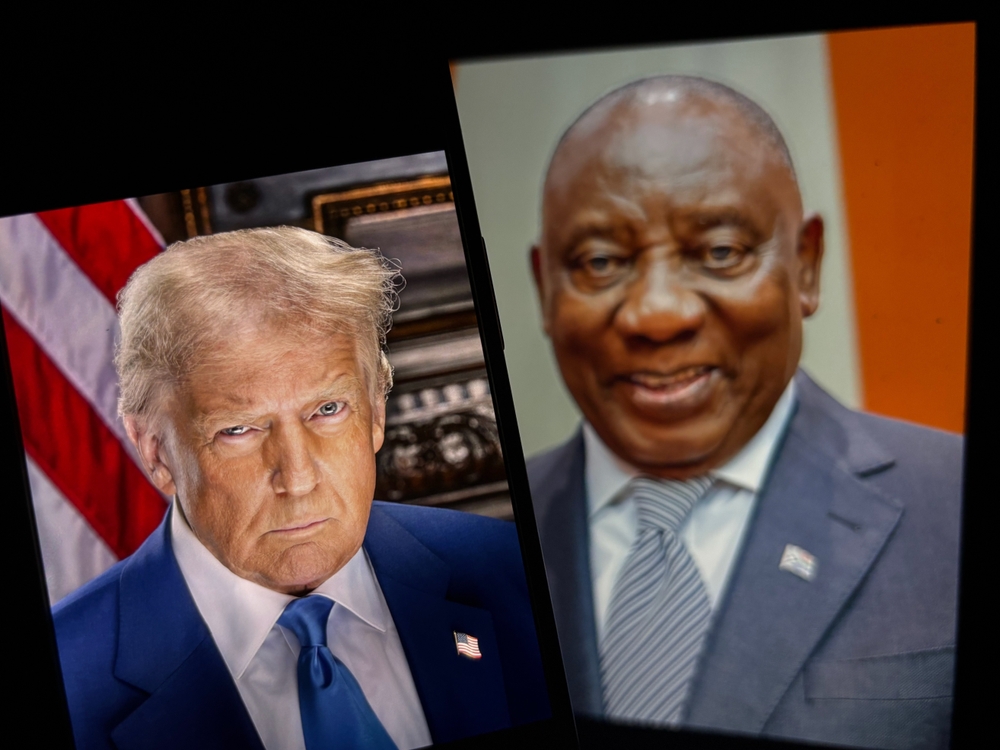
The exception is justified by Trump’s false claim that white South Africans, especially Afrikaner farmers, are victims of racial targeting and “genocide.” During an Oval Office meeting, South African President Cyril Ramaphosa refuted the claims that any genocide was taking place in South Africa. However, Trump presented videos and images that he claimed as valid evidence of a “white genocide.” Videos and images used to support claims were later determined to be either entirely unrelated to farm attacks or sourced from different incidents altogether. For example, one video shared by Trump was actually filmed in the Democratic Republic of Congo.
What the Data Shows
From October 2025 through January 2026, the US Refugee Admissions Program (USRAP) admitted 1,651 individuals into the United States, according to the State Department’s arrivals report. A staggering 1,648 of these arrivals were from South Africa. The other 3 admitted were Afghan refugees who arrived in Colorado in November 2025; however, their admission has since been indefinitely suspended, and they now face possible deportation.
In contrast, the same four-month period in the previous fiscal year, under the Biden administration, saw a total of 37,596 refugees admitted to the U.S. from October through January 2025. During that time, the majority of arrivals were from Africa, South Asia, and the Middle East. This significant difference is not due to a change in capacity but rather a deliberate matter of policy choice.
The Cap Drops to a Historic Low
The Trump administration substantially cut the U.S. refugee ceiling to 7,500 for the 2026 fiscal year, establishing a record low in the program’s 45-year history. This decision starkly contrasts with the robust resettlement figures of fiscal year 2024, during which 100,034 refugees were admitted against a 125,000 ceiling, marking the highest admissions since 1994. The Biden administration had previously maintained the 125,000 ceiling for fiscal year 2025.
The September 30, 2025, announcement of the reduced cap immediately drew criticism for bypassing the mandatory prior consultation with Congress, a requirement explicitly laid out in the Refugee Act of 1980. The Refugee Council USA formally denounced the process as legally defective. The consultation, which involved Deputy Secretary of State Christopher Landau and Deputy DHS Secretary Troy Edgar, finally occurred on November 20, 2025. This was weeks after the Presidential Determination had already been published. The Refugee Act stipulates that consultation must be at the cabinet level and precede the finalization of the determination; consequently, the consultation was both untimely and conducted by officials lacking the requisite rank.
The “White Genocide” Claim Does Not Hold Up
A violent crime epidemic plagues South Africa, impacting all racial groups, with the economically disadvantaged particularly affected. Though farm murders are a factual and prevalent issue, they represent less than 1% of the annual total of over 27,000 murders nationwide in South Africa. Security studies experts, international law specialists, and African affairs analysts have consistently argued that the available figures do not satisfy the legal or factual requirements for genocide. Furthermore, a South African judge, in a ruling on a separate inheritance case in February 2025, dismissed the genocide claim, describing it as “clearly imagined” and “not real.”
The Institute for Security Studies Africa analyzed the same data and arrived at an identical conclusion, indicating that Trump’s characterization of the situation is factually inaccurate. Trump drew his narrative from white nationalist conspiracy theories that had circulated online for years, and he aligned himself with or accepted funding from individuals linked to white supremacist groups. Despite Trump’s insistence on the validity of these false claims, the South African government explicitly denied these allegations, calling them “completely false.” To counter Trump’s claims during their May 2025 Oval Office meeting, Ramaphosa presented data, agricultural experts, and a former South African president. However, these efforts did not persuade Trump to change his stated stance.
The Land Reform Context
Trump’s executive order also cited South Africa’s Expropriation Act as evidence of state-backed racial discrimination. President Cyril Ramaphosa signed the Expropriation Act 13 of 2024 into law on January 20, 2025. The act establishes a legal framework for the government to take private property for public purposes or in the public interest. It explicitly bars arbitrary expropriation. The law allows nil compensation only in narrow, specific circumstances: when owners abandon land, when the state no longer needs land it holds, or when state investment in the land exceeds its market value.
Legal analysis by Good Authority indicates the act’s nil compensation provisions embed strict procedural safeguards. Crucially, we have no evidence of widespread farm seizures since the act’s implementation. As occurs in any functioning democracy, political debate and the courts are handling domestic contestation of the law. For example, in February 2025, the Democratic Alliance filed a constitutional challenge in the Western Cape High Court. They centered their argument on procedural irregularities in the act’s approval, not on the premise that the law permits a racial attack.
The Pipeline and the Plan
In a process taking months rather than years, 59 Afrikaner individuals, described as “refugees,” arrived at Dulles International Airport in Virginia last May. The group arrived on a government-chartered flight after an expedited review process. This review typically spans years, but was completed for them in a matter of months. Federal officials, including Deputy Secretary of State Christopher Landau and Deputy DHS Secretary Troy Edgar, met them on the tarmac. Landau told the group: “I want you to know that you are really welcome here.”
As of January 31, 2026, approximately 2,000 white South Africans had entered the U.S. under the program. In late February 2026, Reuters reported on an internal State Department document that set a new target: 4,500 white South African applications processed per month. The document stated that failing to meet that target “would result in failing to meet a Presidential priority.” To facilitate the surge, the administration planned to install trailer units on U.S. Embassy grounds in Pretoria, South Africa, creating a dedicated processing site.
A Program Within a Program
The scale of the planned expansion is significant. If the 4,500-per-month target holds, the administration would admit 54,000 white South Africans annually, well above the 7,500 total refugee cap set for fiscal year 2026. That discrepancy has not been publicly explained. The administration’s own figures suggest the cap applies to everyone except this group. More than 67,000 white South Africans had reportedly expressed interest in relocating to the U.S. as of early 2026. The infrastructure being built in Pretoria is designed to accommodate that demand.
What Is Happening to Everyone Else
In February 2026, the Department of Homeland Security (DHS) initiated a controversial policy that targeted refugees who had legally entered the U.S. and established lives but had not yet obtained green cards. On February 18, 2026, a memo, which ICE Acting Director Todd Lyons and USCIS Director Joseph Edlow signed, mandated the arrest and detention of these refugees for a “mandatory one-year reinspection for assimilation and public safety.”
This policy threatened approximately 5,600 refugees, particularly in Minnesota. However, the enforcement of these arrests faced swift challenges. U.S. District Judge John Tunheim issued a temporary restraining order in January 2026, and he converted it into a preliminary injunction on February 28, 2026. Judge Tunheim sharply criticized the administration’s action, stating it “turns the American Dream into a dystopian nightmare” and stressing that Congress had never authorized the blanket detention of lawfully admitted refugees. In response, DHS deemed the injunction “lawless” and announced its intent to appeal the ruling to the Eighth Circuit.
A Man Left in the Cold
On February 19, 2026, U.S. Border Patrol agents released Nurul Amin Shah Alam, a 56-year-old nearly blind Rohingya refugee from Myanmar, from a county jail in Buffalo, New York. He had entered the U.S. legally as a refugee. Agents drove him to a coffee shop miles from his home and left him there. Temperatures in Buffalo were below freezing. His family searched for him for five days. On February 24, 2026, police found his body six miles from the coffee shop where agents had dropped him off.
Shah Alam had fled the genocide against Rohingya Muslims in Myanmar, a crisis that the United Nations documented extensively. He entered the U.S. through the same USRAP process that Trump now reserves for Afrikaners. Buffalo Mayor Sean Ryan called his death preventable and the result of “inhumane” decision-making by federal immigration authorities. CBP said agents had given Shah Alam a “courtesy ride” to a “warm and secure location.” He was found dead nearly a week later.
The Racial Architecture of the Policy
More than 1,100 Afghan refugees who were fully vetted and approved for U.S. entry have spent over a year at an inactive U.S. military base in Qatar. They escaped conflict in Afghanistan, cleared the resettlement pipeline, and then stalled when Trump froze USRAP in January 2025. The State Department announced plans to close the camp by the end of 2026, but has not confirmed where those refugees will go. These are not people awaiting vetting. The U.S. government cleared them, and then the policy changed. Meanwhile, the government installs trailers in Pretoria and charters direct flights from South Africa.
Security protocols do not explain the differential treatment of Afrikaner applicants compared to groups like Afghan, Sudanese, Syrian, or Rohingya refugees. For example, Afghan applicants successfully navigated the identical vetting, background checks, and interagency reviews that the USRAP mandates. Therefore, the core distinction is not procedural; it is political. President Trump’s February 2025 executive order, which specifically designated Afrikaners as a priority group, proves this point. While groups like Afghans and Syrians have historically participated in the program, no executive order grants them the priority status that the program’s current operational framework withholds.
The South African Government’s Position
South Africa has not endorsed the Trump program. Chrispin Phiri, spokesperson for the South African Department of International Relations and Cooperation, stated that the government would not interfere with the U.S. program as long as it adhered to legal parameters. Pretoria has, however, consistently rejected Trump’s characterization of conditions in South Africa. The South African government calls the genocide claim false. It argues the Expropriation Act is a constitutionally grounded domestic policy instrument designed to correct apartheid-era land inequalities, not an instrument of racial targeting.
South Africa’s Democratic Alliance challenged the Expropriation Act in the Western Cape High Court on procedural grounds, not on any claim of anti-white intent. That internal legal process is the mechanism South Africa uses to resolve constitutional disputes. The Trump administration’s choice to frame that domestic legal process as evidence of genocide and to use it as justification for a racially exclusive refugee program, overrides what South African courts, politicians, and experts are actively debating at home.
A Program Designed by Its Outcomes
Harvard’s Carr Center for Human Rights Policy published an analysis in May 2025 describing the Afrikaner exception not as a humanitarian gesture but as a strategic repurposing of USRAP to advance political and racialized priorities. Krish O’Mara Vignarajah, President and CEO of Global Refuge, stated that concentrating the majority of available slots on one group marks a “profound departure from decades of bipartisan refugee policy rooted in law, fairness, and global responsibility.” Ja’han Jones, writing for MS NOW, drew a direct historical parallel to the Immigration Act of 1924, which established strict ethnic quotas openly supported by white supremacist organizations. That act prioritized Northern European immigrants above all others. The current policy produces a functionally similar outcome: one ethnicity moves through a government-built fast-track channel while others face suspension, detention, or death.
The numbers at the core of this story are not ambiguous. In fiscal year 2024, the U.S. admitted 100,034 refugees. In the four months following the USRAP suspension, the U.S. admitted 1,651, and all but three came from one country. The administration set a 7,500 annual cap, then internally targeted 4,500 white South African admissions per month. Those two figures cannot coexist unless one group operates outside the cap entirely. No official explanation accounts for that gap. The data is public. The policy is in writing. What it produces is visible.
Read More: Live Large in Europe: 10 Cities Where Your Money Goes a Long Way