
On a grey Monday, under those fluorescent lights that make everything look a little harsher than it really is, Emily felt the first crack. On paper and on her Instagram feed, Emily’s life looked enviable. She was a senior leader at a fast-growing company, had two kids, had a partner who tried really hard, and had just received an important promotion that should have felt like a victory but instead felt like a burden.
That morning’s leadership meeting was supposed to be routine, but as her team went around the table, Emily noticed her chest tightening, like someone was slowly cinching a strap under her collarbones, and her head starting to pound, as if a small hammer were knocking behind her temples. Her assistant slid a fresh stack of reports toward her and, as the numbers blurred on the page, she heard someone say, “Great quarter.”
By the time she closed her office door behind her, her hands were shaking. Notifications kept piling up in the corner of her laptop screen, and an email from her boss was sitting at the top of her inbox: “You’re doing great. Let’s push even harder next quarter.”
Her stomach dropped. She was supposed to feel proud, but instead, she pressed her palms into her eyes until stars appeared.
In our first coaching session, she told me, “I know logically and on paper I look very successful, but I just can’t feel it… It’s like I’m always two steps away from being found out.”
As we worked together, a story emerged. She recalled proudly showing her parents the 93% she’d earned on a difficult math test, her mother’s smile fading as she glanced at the paper and asked, “What happened to the other seven points?” followed by, “You’re capable of more, Emily. Don’t settle.” Emily nodded and retreated, promising to try harder next time, and somewhere in those moments, she internalized that achievement was the currency she used to buy acceptance, a transaction she kept repeating long into adulthood.
Somewhere along the way, Emily internalized a powerful limiting belief: worth equals performance. Rest felt dangerous, and saying “no” felt like walking into the line of fire without any protection. On the outside, she was calm and composed, the kind of leader people described as impressive and stoic, but on the inside, she lived in a permanent state of emergency. Her brain, doing exactly what it evolved to do, could not tell the difference between a missed deadline and a life-threatening event.
Our ancestors’ nervous systems kept them alive on open plains, long before there were inboxes or performance reviews. Their hearts pounded and their muscles primed at the slightest rustle in the grass because reacting fast, not stopping to assess whether they were overreacting, was what kept them alive. That wiring hasn’t disappeared simply because modern “threats” come with Wi-Fi and job titles. That ancient alarm’s still there, faithfully doing its job, even when the so-called threat is nothing more than a vague subject line or a four-word text that reads, “We need to talk.”
Survival Mode: A Biological State, not a Personal Failure
Many of us live in survival mode even when most of the dangers we face are psychological rather than physical. That tension between our biological design and modern life, sometimes referred to by experts as evolutionary mismatch, is burning a lot of people like Emily down to the nub. Maybe you feel a bit of that, too.
When I talk about survival mode, I’m talking about a biological state of chronic activation. It’s your nervous system doing its best to keep you alive, even if most of the danger is psychological. If you grew up with people telling you to “push through,” “try harder,” or “don’t be so sensitive,” it is easy to mistake survival for a personal trait. It usually manifests in beliefs that become fused with our identities, like:
“I’m just driven.”
“I’m a perfectionist.”
“I thrive under pressure.”
“This is what it takes to be successful.”
Under the hood, however, research suggests that when our system detects a threat, it releases stress hormones like cortisol and adrenaline, and blood is diverted away from processes like digestion and repair toward what seems urgent needs in the moment, like “do whatever you must to avoid harm.” Modern neuroscience explains that the brain’s threat-detection networks are wired to overestimate danger so even a neutral email can activate circuits designed to keep our ancestors alive. While survival mode is incredibly useful and highly adaptive when our life is at risk, it’s physiologically expensive and can cause us tremendous harm in the long term.
Decades of neuroscience research show that chronic exposure to stress is associated with changes in brain regions that are essential for memory, mood, and clear thinking. When stress is frequent and uncontrollable, these regions can shrink or become less efficient, while the parts of the brain that scan for danger grow more reactive. Even relatively mild stress can rapidly lower our ability to hold information in our minds and make good decisions. In other words, our “wise, big-picture” brain goes dim, and our “better safe than sorry, assume the worst, react now” brain takes the wheel.
So, if you have ever noticed that under pressure, you snap at people you love, you’re not broken, and you’re not alone. You’re human, and your biology is prioritizing survival.
Although sometimes survival mode can look like a full-blown panic attack or a dramatic breakdown, it more often looks like:
- Being awake at 3 a.m., replaying one conversation from earlier that day.
- Saying “yes” out loud while, internally, every bone in your body says “no.”
- Numbing out with your favorite app or substances and calling it rest, even though you don’t feel any more rested afterward.
- Snapping at people you love for something small, then drowning in shame.
Underneath those behaviors is often a nervous system that has slipped out of its grounded, present-focused state and into survival mode. Polyvagal theory explains that our bodies are constantly scanning the world for cues of danger or safety and deciding in a split second whether we can stay open or whether we need to protect ourselves. When life starts to feel like one long string of demands and expectations, we can get stuck toward the survival end of that ladder.
Here’s the part most of us were never told: your exhaustion is not a moral failing but a physiological consequence of a nervous system that has been working double shifts without enough recovery to come back to baseline. You’re not lazy or ungrateful or “bad at coping.” You’re a human in a world that keeps asking you to stay on high alert, even when nothing is actually on fire.
Reclaiming Your Agency
Image Credit: Shutterstock
If survival mode is largely biological, where’s the hope? Most of us can’t quit our jobs tomorrow, move to a cabin in the woods, and meditate eight hours a day (nor do we want to, even if we could). While practices that induce transcendence, like meditation, awe, flow, and the growing field of psychedelic-assisted therapy, can offer some relief for some people by quieting the brain’s alarm systems temporarily, those openings work best when our daily patterns begin to shift. This is where agency comes in.
When I talk about agency, I mean the capacity to make intentional choices, supported by the belief that those choices matter and can influence your experience and the world around you.
There are two pieces here:
- Capacity: the actual internal space to perceive options.
- Belief: the story that says, “my choices count,” instead of “nothing I do will change anything.”
Agency is a way to reclaim the gap between trigger and response, that small but powerful moment when you want to fall back into an old pattern, and instead you choose to interrupt the script. It’s the pause where you notice the tightness in your chest before you fire off that angry email or the instant of clarity where you realize you don’t have to repeat the same loop again with your siblings. In that sliver of space that’s barely noticeable at first but that can grow with practice, you begin the change from being carried by your conditioning to becoming an active participant in your own life. That’s the heart of agency: tiny acts of self-authorship that slowly change the direction of your life.
The good news? As you practice agency, you get better at it. Neuroplasticity research shows that new neural pathways can form throughout life when we repeatedly practice new patterns of thought, emotion, and behavior. Every time you interrupt an old survival loop and choose something slightly different, you cast a vote for a new pattern, even if the vote feels tiny.
Instead of trying to bully yourself into being calm and happy, you’re focusing your attention on new experiences of curiosity and meaning, one small decision at a time.
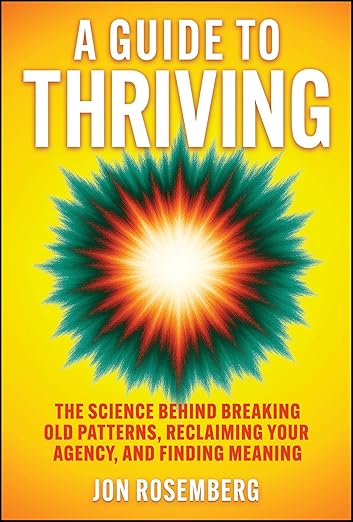
To make this actionable, I lean on a framework called AIR, which stands for Awareness, Inquiry, Reframing. It is the backbone of my work and my book, A Guide to Thriving.
The AIR Method
Think of AIR as three turns of attention:
- Awareness: noticing what is actually happening in your mind, emotions, and body.
- Inquiry: asking open-ended, compassionate, curious questions instead of defaulting to “what’s wrong with me?”
- Reframing: choosing a more empowering narrative that still respects reality.
Awareness
Awareness begins the moment you stop gaslighting your own experience. You stop telling yourself “It’s fine” when your body and emotions are clearly insisting otherwise. With Emily, Awareness began by asking, “What’s happening in your body right now, as we talk about this situation?” She paused, reflected, and then shared, “My jaw is tight, and I can feel my hands are clenched under the table. My heart feels like it is trying to escape my chest, and I truly feel like I’m carrying the weight of the world on my shoulders.”
Then we looked at her inner dialogue, and she articulated the story she was telling herself, “If I drop the ball once, they will realize I never deserved this role. I can’t let that happen!”
Awareness connected her thoughts, emotions, and physical sensations into a pattern we could explore together. Here are a few simple Awareness questions that may work for you:
- What am I thinking right now, and does this thought feel familiar?
- What emotion is here beneath the story?
- Where do I feel it in my body: chest, throat, gut, jaw, hands?
You are not trying to fix anything but simply collecting data with as much kindness as you can muster. Awareness is the first act of reclaiming agency because we can’t choose differently if we’re stuck in a pattern we refuse to acknowledge.
Inquiry
Once we notice what is happening, many of us do something very human and very harsh. We attack ourselves:
“Why am I like this?”
“Other people can do it.”
“I should be over this by now.”
Inquiry is the practice of moving away from self-criticism and toward curious, compassionate questioning. With Emily, once we noticed her body was bracing for the next imaginary attack in every meeting, we asked: “When was the first time you remember feeling this exact mix of tension and dread? Whose voice does this inner critic sound like? What did you have to do, as a kid, to feel safe and loved?”
Her memory went back to that math test and the missing seven points, and to a childhood where achievement was the toll that had to be paid for acceptance. Then, the questions became slightly different: “What belief about success made it seem possible for you to ignore pain for this long? If this pain had language, what would it be trying to tell you?”
Inquiry treats your survival patterns as protective responses instead of defects. Hyper-achievement, people-pleasing, perfectionism, and numbing all started as attempts to keep us safe and to earn love. Here are a few inquiry questions you can experiment with:
- What’s this reaction trying to protect me from right now?
- Where did I learn that this pattern was the safest way to be?
- If this part of me could speak, what would it be afraid of happening if I changed?
Something shifts when we ask those questions. Our nervous system responses stop feeling like problems to fix and start feeling like signals trying to help.
Reframing
Reframing doesn’t mean relying on platitudes like “everything happens for a reason” or “positive vibes only” pasted over very real pain. Instead, reframing is the ongoing work of choosing stories that are more empowering.
Emily’s core belief when we met was simple: “My value depends on my success.” And no amount of “you’re amazing” speeches softened that belief because it lived in her bones, built over the years. As she practiced AIR, another belief slowly began to surface: “My worth is inherent. My success is one way I express it, but it’s not the condition for it.”
That reframe, as most reframes, didn’t arrive in some dramatic epiphany but instead in mundane experiments, many of which failed at first. Leaving the office at 6:30 instead of 9:00. Saying, “I don’t know, what do you think?” instead of always jumping with an answer before anyone had a chance to speak. Letting a PowerPoint slide be good enough instead of perfect, and noticing that no one stormed into her office to revoke her promotion. Each small act of agency reminded her that she was allowed to exist without constantly earning her place.
Reframing works best when it is very specific:
- From “I’m terrible at boundaries” to “Saying no still feels unsafe for me, and I can still practice it in small, safe ways.”
- From “I’m broken” to “Parts of me learned very intense survival skills. Now I’m learning skills for thriving.”
- From “This is just who I am” to “This is who I became to get through what I went through. I’m allowed to become someone new.”
Read More: Subtle Signs Your Body Sends When You’re Under Heavy Stress
A Guide to Thriving
If survival mode is the state in which we constantly brace for impact, thriving is what becomes possible when we have enough bandwidth to meet life with flexibility instead of rigidity. Neuroscience tells us that when the brain is no longer flooded with threat signals, whole networks involved in empathy, creativity, compassion, and complex problem-solving that were dimmed begin to come back online. Your body registers the change too, as your breath steadies and muscles unclench. Thriving can often begin by brief experiences of expanded awareness or bigger transcendental moments that can signal to the brain that it’s safe enough to access a wider range of responses. In that space, life stops feeling like something you have to outrun.
For greater clarity, thriving does not mean everything is going well, but that even when we’re facing difficulties or challenges, we can still access:
- Enough calm to respond intentionally rather than just react.
- Enough connection to others to feel supported.
- Enough presence to experience joy or beauty.
- Enough meaning to understand that our pain is part of a much larger story.
In my work, I often describe the journey between survival mode and thriving as a spiral. Most of us don’t get to climb out once and stay out forever, but instead we circle through survival mode and thriving again and again. One difficult conversation can pull you down the spiral for a while, and one small act of agency can help you climb back up.
The difference, over time, is that you stop feeling like a helpless passenger. Through AIR and small acts of agency, you begin to feel like an active participant in your own life again. Thriving is not the absence of challenges but the presence of enough agency, meaning, and connection to let pain transform you instead of only hardening you.
Emily did not leave her job to live on a mountaintop. From the outside, her life today looks similar to the one she had when we started working together. What changed was the question running in the background. When we first met, that question sounded like: “How do I keep this up so no one finds out I’m not enough?” That question made every email and every meeting feel like a test she had to pass to keep her right to exist.
Months later, she was sitting alone in her office after another leadership meeting, but instead of diving straight into her inbox, she closed her laptop and let her hands rest on the armrests. She stared at the blank wall for a full minute. A different question appeared: “What would my life look like if my worth never had to be earned?”
She didn’t have a neat answer or suddenly feel enlightened and fearless, but she did walk out of that room with a new internal reference point. So, from that day on, when she practiced AIR, she did it anchored in that question.
- Awareness: “Am I about to say yes out of fear instead of agency?”
- Inquiry: “Whose expectations am I trying to live up to right now?”
- Reframing: “I can still be a committed leader and a loving parent without sacrificing my health. My worth is not hanging on this one deliverable.”
Her nervous system gradually stopped treating every slight error as evidence of unworthiness, and her team noticed that she listened more and defended less. Colleagues who once rehearsed their feedback began speaking to her plainly, sensing that she was no longer bracing for impact with every suggestion. At home, her partner noticed the evenings were lighter, like the way disagreements could actually be debated openly instead of falling into silence. Her kids noticed that she could sit on the floor and actually be there, present. She was also learning to hear whispers of discomfort in her body before they became screams, the early signals that once went ignored became an invitation to pause rather than a reason to push harder.
This is at the heart of moving from survival mode to thriving: a different relationship to your own pain and to your own capacity to choose.
Life may still be full of responsibilities and people who need you, but somewhere beneath all that noise lives a part of you that already knows what thriving would feel like. That part rarely shouts, and it’s waiting for you to turn toward it with enough curiosity and compassion to hear what it has been trying to say for years.
Today, instead of asking “What is wrong with me?”, try asking “Where in my life am I still living as if there is a tiger in the room, and what is one small choice I can make that moves me from survival toward thriving?”
Written by: Jon Rosemberg
With over two decades of coaching Fortune 500 executives and global teams through deep transformations, Jon Rosemberg has learned firsthand that growth begins when we courageously reclaim our agency. His personal journey, forged by immigration, loss, and career reinvention, inspires him to blend hard-won business insight with cutting-edge research to guide others toward greater meaning.
Driven by his belief in human potential, Jon co-founded Anther, a firm dedicated to transforming uncertainty into possibility. He previously led high-impact initiatives at Walmart, Procter & Gamble, Indigo, and GoBolt. Jon holds an MBA from Cornell University and a Master of Applied Positive Psychology from the University of Pennsylvania, where he serves as an assistant instructor. He is the author of A Guide to Thriving. Originally from Caracas, Venezuela, he now lives in Toronto with his wife, Adriana, and their two sons.
You can explore more of Jon’s work and insights on his website, LinkedIn, and Instagram.
Read More: Top Natural Supplements and Vitamins to Help Relieve Anxiety and Stress