
Joan Bennett Kennedy taught her son something when he was 12 years old, lying in a hospital bed with part of his leg gone from cancer. He was trying not to cry. Trying to be brave. She held his hand and told him, “Brave boys can cry, too.”
That was the kind of woman she was. She understood pain and knew what it meant to suffer in public while everyone expected you to smile. She spent decades trapped between the Kennedy family’s demand for strength and her own need to be human. When she finally broke free, she taught America the same lesson she taught her son. It’s okay to cry. It’s okay to admit you’re broken.
She died peacefully in her sleep on October 8, 2025, at her Boston home. At 89, Joan was one of the few remaining Kennedy family members who lived through the JFK presidency.
She was an elegant woman who endured unimaginable pain and transformed it into something that helped millions of people talk honestly about addiction. “I will always admire my mother for the way that she faced up to her challenges with grace, courage, humility and honesty,” Ted Jr. told the Boston Globe.
She didn’t begin as the woman who broke the silence. Joan was a shy pianist who knew nothing about politics and wanted nothing to do with public life.
The Woman Before Camelot
Virginia Joan Bennett was born September 2, 1936, in New York City. She grew up in affluent Bronxville, where her father, Harry Wiggin Bennett, worked as an advertising executive. Music came first in her life. She was an accomplished classical pianist from a young age, spending hours at the keyboard while other children played outside.
She also worked as a teen model for major brands. Revlon made her their girl. Coca-Cola put her on Eddie Fisher’s television show. Her face sold products across America before she could vote. The camera loved her, but she loved the piano more.
At Manhattanville College, she was shy and reserved. She stayed away from campus politics and spent her free time in the music room. She knew almost nothing about the Kennedy family when she first heard the name. Politics meant nothing to her, but music meant everything.
This quiet, musical young woman was about to marry into the most demanding family in America.
The Ill-Fitted Marriage
In October 1957, Joan met Ted Kennedy when the Kennedy family came to dedicate a gymnasium at her college in memory of his sister Kathleen, who had died in a plane crash. His sister Jean, Joan’s college friend, introduced them. Ted was a law student at Virginia, the youngest Kennedy brother, tall and charming and used to getting what he wanted.
The romance moved fast. Too fast. Joan grew nervous about marrying someone she barely knew and wanted to wait. Her father suggested postponing the ceremony for a year, but Joseph P. Kennedy Sr. insisted the wedding proceed, according to CNN’s “American Dynasty: The Kennedys” documentary. Joseph Kennedy had decided. The wedding was set for November 29, 1958. Joan was only 22.
The wedding happened weeks after JFK won his Senate reelection. The political machine was already running at full speed. Joan found herself at the altar, surrounded by people she’d met only months before.
“Joan was shy and a really reserved person, and the Kennedys aren’t,” Adam Clymer, who wrote a biography of Ted Kennedy, the Associated Press.
She struggled from the first day. At dinner, everyone talked at once. Political arguments lasted through dessert. She sat quietly, overwhelmed. The Kennedys expected their women to be tough, athletic, and politically savvy. Joan was none of those things. She preferred Chopin to touch football.
Three children came quickly. Kara in 1960, during JFK’s presidential campaign. Ted Jr. in 1961, as the family entered the White House spotlight. Patrick in 1967.
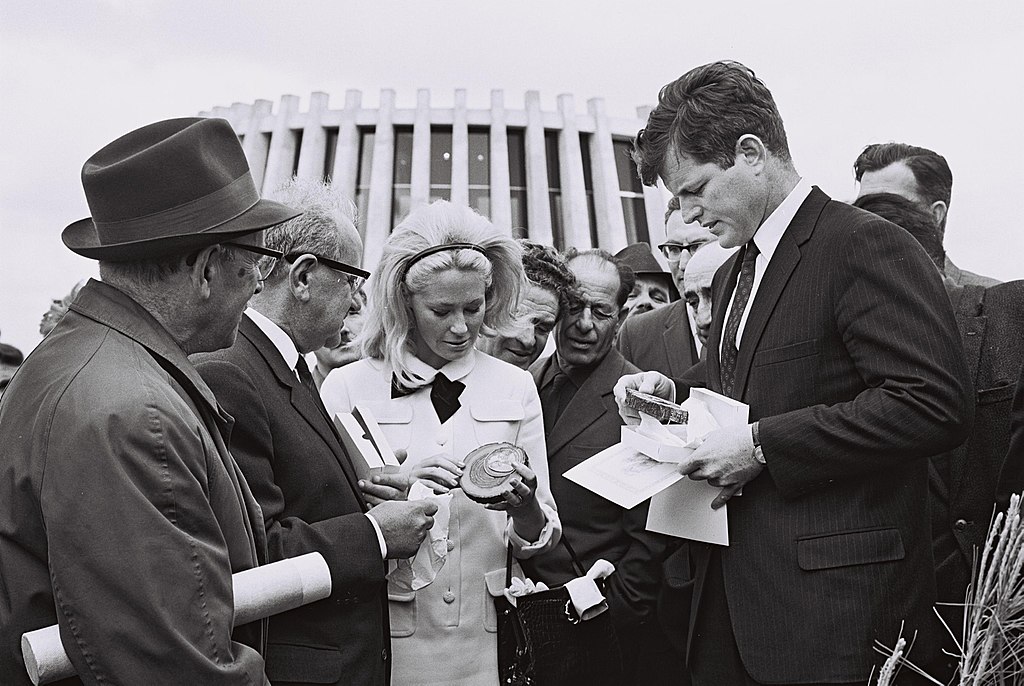
The political wife’s role took over. She attended fundraisers and made small talk with donors. She opened campaign rallies with piano performances. The music that had been her refuge became another duty.
Then the tragedies started.
The Violence and The Losses
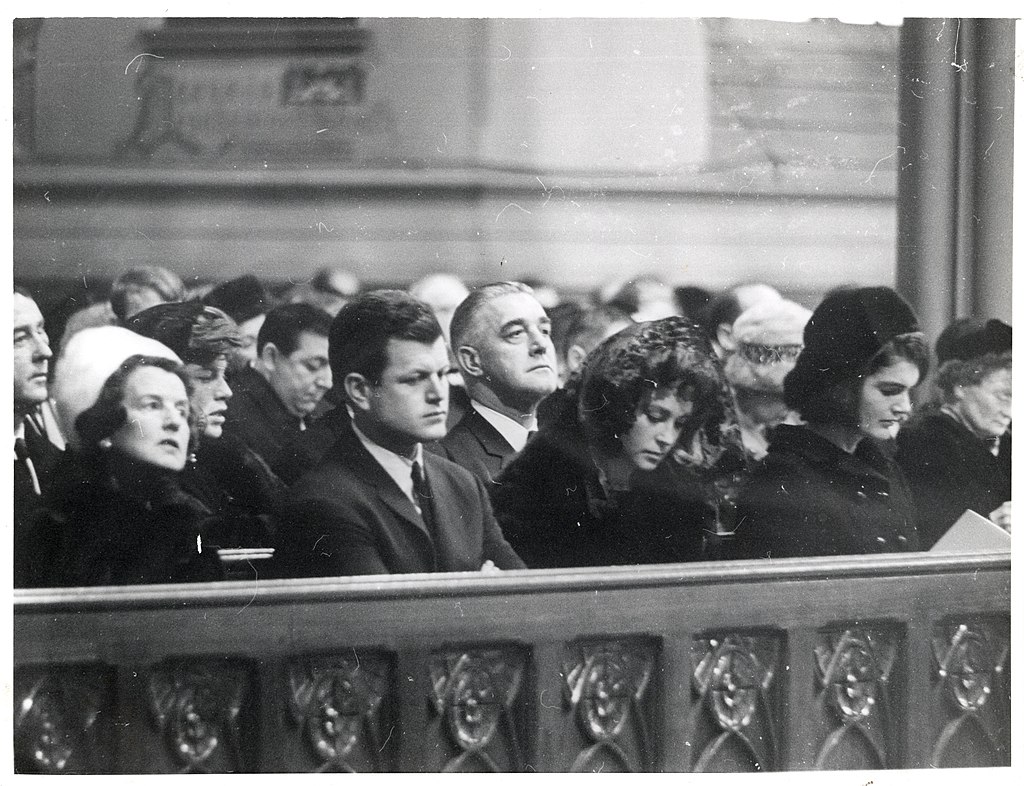
President John F. Kennedy was assassinated in November 1963. Joan stood with the Kennedy women at the funeral while cameras broadcast their grief to the world. The next year, Ted’s plane crashed in western Massachusetts. He nearly died. His back was broken. A colleague was killed. While Ted recovered in the hospital, Joan took over his campaign appearances. She spent months standing at podiums across Massachusetts, reading prepared remarks.
Robert F. Kennedy was assassinated in 1968 while running for president. Another Kennedy funeral. The family was expected to show strength in public, no matter what they felt in private.
July 1969 brought Chappaquiddick. Ted drove his car off a bridge on Chappaquiddick Island, and his passenger, 28-year-old Mary Jo Kopechne, died. Joan was pregnant and confined to bed rest after two previous miscarriages. She attended Kopechne’s funeral in Pennsylvania anyway. Three days later, she stood beside Ted in court as he pleaded guilty to leaving the scene of an accident. She was pregnant and pale and held Ted’s hand for the cameras. She suffered her third miscarriage shortly after.
Her children suffered too. In 1973, their son Ted Jr. was diagnosed with bone cancer at age 12. Doctors amputated part of his right leg, and he endured two years of experimental chemotherapy. Ted was often in Washington, and Joan managed the medical crisis mostly alone.
By the mid-1970s, Joan had found a way to cope. She drank.
The Breaking and The Honesty
Ted’s infidelities were constant, and he didn’t hide them. Washington gossip columns tracked his affairs like sports scores. “Of course the stories hurt my feelings,” Joan told TIME Magazine in 1979. “They went to the core of my self-esteem.”
Her first DUI arrest came in 1974 in Virginia. She couldn’t handle much alcohol. Two drinks made her eyes go glassy, and three drinks knocked her out. Performing with symphonies again didn’t help. Seeing psychiatrists three times a week didn’t help. McLean Hospital and other treatment centers couldn’t stop it. Even megavitamin therapy failed, TIME Magazine reported. The attempts at sobriety came and went.
In 1978, the couple separated after 20 years of marriage. Joan moved to a Boston apartment. In her recovery, she saw a psychiatrist and attended Alcoholics Anonymous meetings in Boston. She started working on a master’s degree in education at Lesley College.
Late in 1978, she gave interviews to People and McCall’s magazines. She spoke openly about her addiction. Alcohol had been her way to cope with unhappiness and social pressure. Her recovery through AA’s 12-step program became part of the conversation.
This was 1978. Betty Ford had only recently spoken about her addiction. At this time, Celebrity confessions about alcoholism were rare. The stigma was enormous.
RFK Jr. later called her “one of the first prominent women in America to publicly acknowledge her struggles with alcoholism and depression,” according to Fox News. Her son Patrick said, “Mom was a powerful example to millions of people with mental health conditions. Her courage and candor helped break stigma and inspired others to seek help and healing,” he told the Boston Globe.
The interviews made national news. The 1980 presidential campaign was coming.
The Last Campaign
When Roger Mudd asked Ted why he wanted to be president in a television interview that November, Ted hesitated. His eyes slid to the ceiling. Then he began talking about natural resources, about education, about technology. The answer went on for 336 words without ever landing anywhere. What’s worse is he never gave a reason for running. The words had nothing behind them.
The interview aired on CBS on November 4. Three days later, Ted officially announced his candidacy. People began asking the obvious question. Did Ted Kennedy even want to be president?
Joan opened his rallies with piano performances. She smiled for the cameras. The couple stood together at campaign events. But anyone watching could see the distance between them. The marriage was over in every way except on paper.
Bumper stickers that year read “Vote for Jimmy Carter, Free Joan Kennedy.” Voters recognized her sacrifice. They knew she had stayed far longer than she should have.
Jimmy Carter won. When Ted conceded, the couple stopped pretending the marriage still existed. They announced plans to divorce in 1981, and the divorce was finalized in 1983 after 24 years of marriage.
Joan never remarried.
For the first time in her adult life, she could focus on herself. However, it wouldn’t happen overnight. The years after the divorce brought setbacks and relapses. She continued struggling with alcohol addiction. But slowly, she built a life that was hers.
Rebuilding
In 1982, Joan earned a master’s degree in education from Lesley College and returned to classical piano seriously. Her 1970 concert debut with the Philadelphia Orchestra had earned standing ovations. Now free from the Kennedy schedule, orchestras around the world invited her to perform. The Boston Pops. Rachmaninoff in Vienna. Gershwin in London.
Joan combined her performances with talks about arts education. Music should be available to all children regardless of income, she argued. Teaching classical music to kids in Boston public schools became part of her work. Bringing keyboards to community centers in Roxbury and Dorchester. The girl who had found refuge in music was helping other children find that same refuge.
In 1992, she published “The Joy of Classical Music: A Guide for You and Your Family.” Her former sister-in-law, Jackie Kennedy Onassis, edited it at Doubleday. The book was about Mozart and Brahms, about how parents could help their children appreciate classical music.
In 2000, Joan gave an interview that explained what all of this meant to her. “It’s such a relief now to be free,” she told the Boston Globe. “So much of my married life was about keeping secrets and pretending that I was doing great and was happy. But once you sober up, the whole idea is to become honest with yourself and other people. I mean, all the secrets I’ve had to keep, mine and all the secrets of the Kennedy family. I don’t have to do that anymore. It’s such a relief to be free. To be a genuine person.”
The Disease Continued
Her addiction to alcohol remained a chronic issue despite periods of sobriety. She was arrested multiple times for drunk driving and went through court-ordered rehab programs. She’d stay sober for months, sometimes years, then relapse.
In July 2004, a court appointed Ted Jr. as her legal guardian. The family was trying to protect her.
April 2005 brought a crisis. Someone found Joan unconscious on a Boston street in the rain. She was hospitalized with a concussion and a broken shoulder. According to a 2006 Boston Magazine investigation, Joan had been drinking vanilla extract and mouthwash. Both contained enough alcohol to cause severe kidney damage. Her doctors said she was within a year of needing dialysis. Her children feared they would lose her.
That year, both sons were granted temporary guardianship. A court ordered strict guardianship to protect her finances and medical care. This wasn’t abandonment but an act of love. Her children were trying to save her life.
This is what addiction looks like in its late stages. There is no amount of privilege that can protect you from it. The disease is a medical condition, and it had hijacked her brain.
Finding Peace
The 2005 crisis became a turning point. Joan entered rehab, and this time, something changed. Under her sons’ guardianship and with the right care, she found stability and achieved the sobriety that had eluded her for decades. The years that followed were quiet. She lived independently in Boston and stayed out of the public eye.
Ted died of brain cancer at his home in Hyannis Port in 2009. Joan attended his funeral at Our Lady of Perpetual Help Basilica. Six years later, she appeared at the dedication ceremony for the Edward M. Kennedy Institute and received a standing ovation.
The woman who had struggled so publicly with addiction spent her final two decades in recovery. Boston gave her privacy. The community gave her space to heal. She had finally found peace.
Read More: Maria Corina Machado Honors Trump with Nobel Dedication as He Awaits 2026 Prize Consideration
What She Left Behind
Her sons watched her struggle. They watched her break. They watched her choose honesty when silence would have been easier. The lessons stayed with them.
Patrick Kennedy co-authored the Mental Health Parity Act in 1996, requiring equal insurance coverage for mental illness and addiction treatment. And then after leaving Congress, he founded the Kennedy Forum to fight stigma. He said his mother became a powerful example to millions of people with mental health conditions.
Ted Jr. became a disability rights lawyer and Connecticut state senator. “I will always admire my mother for the way that she faced up to her challenges with grace, courage, humility and honesty,” he told the Boston Globe. “She taught me how to be more truthful with myself.”
The brothers credit her with showing them that vulnerability can be strength.
The influence spread beyond her children. RFK Jr. called her his “partner in recovery,” according to Fox News. She inspired him with her courage to speak openly when silence was expected. Maria Shriver praised how Joan shared her struggle with addiction so that others could share theirs.
Her honesty in those 1978 interviews changed something in American culture. Addiction was medical, and not moral. She made it acceptable for others to seek help. People who were also struggling saw themselves in her story and felt less alone.
Her last public appearance came at the Kennedy family’s July 4, 2025, gathering on Cape Cod. Her children surrounded her. Nine grandchildren. One great-grandchild.
Three months later, on the morning of October 8, she died peacefully in her sleep at home. Her death certificate listed dementia as the cause.
The Funeral
Eight days later, the family gathered to say goodbye.
October 15, 2025. St. Anthony Shrine in Boston, the humble streetfront church where she had attended Saturday evening Mass for years. The Kennedy family filled the pews, spanning four generations. Her sons, Ted Jr. and Patrick, both gave eulogies.
Ted Jr. told a story from his childhood that moved everyone, according to WBUR’s funeral coverage. When he was 12 and had cancer, when part of his leg had been amputated, he tried to be brave. He tried not to cry. His mother held his hand and told him something he never forgot. “Brave boys can cry, too,” she said.
Joan Bennett Kennedy entered a world that wasn’t made for someone like her, and she paid an enormous price for that mismatch. But in her darkest moments, she chose honesty over performance. That choice in 1978 changed how Americans talk about mental health and addiction.
She proved you could be broken and still be brave. Her elegance wasn’t in hiding her pain but in sharing it. She touched so many hearts because she was willing to show them her own.
Read More: Should U.S. Presidents Be Allowed to Serve Beyond Age 65? The Debate Heats Up