
Rivers across the Pacific Northwest are missing something critical to how they function, and it’s not water. It’s wood. Fallen trees, root wads, whole logjams. A healthy river in this part of the country was never supposed to be a neat, fast-flowing channel. It was a tangle of downed timber, braided side channels, and seasonal floods that spread water across the surrounding land and soaked it like a sponge. That wood slowed the current, pushed water out onto floodplains, recharged groundwater, and built the deep pools and gravel beds that form the habitat salmon depend on at every stage of their lives, the same structure whose restoration now drives the greatest ecological effort in the American West.
For most of the last century, people pulled all of it out. Loggers built splash dams and dynamited them open to flush timber downstream, scouring riverbeds to bare rock. Ranchers let cattle strip the banks. Railroad crews armored floodplains with stone. And starting in the mid-20th century, government biologists drove bulldozers straight into streams to clear logjams because they believed the wood was blocking the salmon.
Every group had a different reason, but none of them understood that the wood was holding the river together. Without it, the water sped up, cut the channel deeper, and disconnected it from the floodplain entirely. The river became a shallow, overheated trench. That happened across the region, watershed by watershed, and salmon populations collapsed with it.
Now tribal nations, federal agencies, and conservation groups are trying to reverse more than a hundred years of damage.
The People Undoing the Damage
Almost 40 years ago, a young habitat biologist named Scott Nicolai started his stream restoration career by taking logs out of rivers. In a 2018 report by Courtney Flatt for OPB, the Pacific Northwest’s public broadcasting network, Nicolai described how biologists in that era thought about wood in water. If they saw a logjam, they called it a barrier. They wanted streams to flow freely and unobstructed because they believed that would help fish move upstream. So they removed the wood, and the floodplains disconnected from the rivers almost immediately. The channels cut deeper, the water ran faster, and the streams lost their ability to hold anything.
He is now doing the opposite. As a habitat biologist with the Yakama Nation, Nicolai oversees what became the largest stream restoration effort in the Northwest, putting more than 6,000 logs back into remote streams across more than 24 miles of waterways on the Yakama Reservation and ceded land managed by private landowners, the U.S. Forest Service, and the Washington departments of Fish and Wildlife and Natural Resources. The work is still expanding. The most recent phase, the Dry Creek restoration between river miles 1.8 and 3.8, was posted for contractor bidding in January 2026.
The Yakama Nation is not working around someone else’s legacy. Their own past biologists helped cause the damage, and they know it. Phil Rigdon, director of the Yakama Nation Department of Natural Resources, said in the same OPB report that they are trying to learn from their mistakes and find a better way to manage. Nicolai was more direct about what that old way of thinking actually looked like. He said they used to treat their streams like they were just for drainage, and that they are learning it was not a great idea.
So how do you get 6,000 logs into these streams? Many of these waterways run through roadless terrain where old logging roads washed out decades ago. The logs travel by air. 4 at a time. On a long cable hooked beneath a helicopter that flies them about a mile and a half from a staging area to the drop point. Biologists mark landing spots in advance with pink and blue flagging tape.
On the banks of the Little Naches River in Central Washington, the Yakama held a ceremony while the first helicopters worked overhead. Tribal elders and partner agencies had gathered to watch the largest phase of the project get underway. Former tribal chairman Jerry Meninick said it was very simple, what they were asking for. To bring what was rightfully part of this land back to them.
The logs come from the hillsides directly above these watersheds. Douglas fir, grand fir, and cedar, harvested from forests that federal and state agencies spent most of the 20th century protecting from wildfire. That protection left the stands overgrown and packed with trees competing for light and water, one bad fire season away from burning catastrophically. The Nature Conservancy had been thinning those stands to reduce wildfire risk, and instead of leaving the wood on the forest floor or selling it as lumber, they redirected it to stream restoration.
Reese Lolley, director of forest restoration and fire for the Conservancy in Washington, told OPB they wanted whole-landscape restoration. Manage the forests above, restore the rivers below, all with the same material. Some of the thinned timber would have been marketable, and some would not have sold at all, but all of it had more value in the water. The forests get thinner and safer, and the rivers get back the wood they lost. The effort runs on funding from eight agencies, including the Bonneville Power Administration, and 6 partner organizations.
How a River Rebuilds Around Its Wood
The Elwha River on Washington’s Olympic Peninsula is probably the best place in the region to watch what happens once the wood goes in.
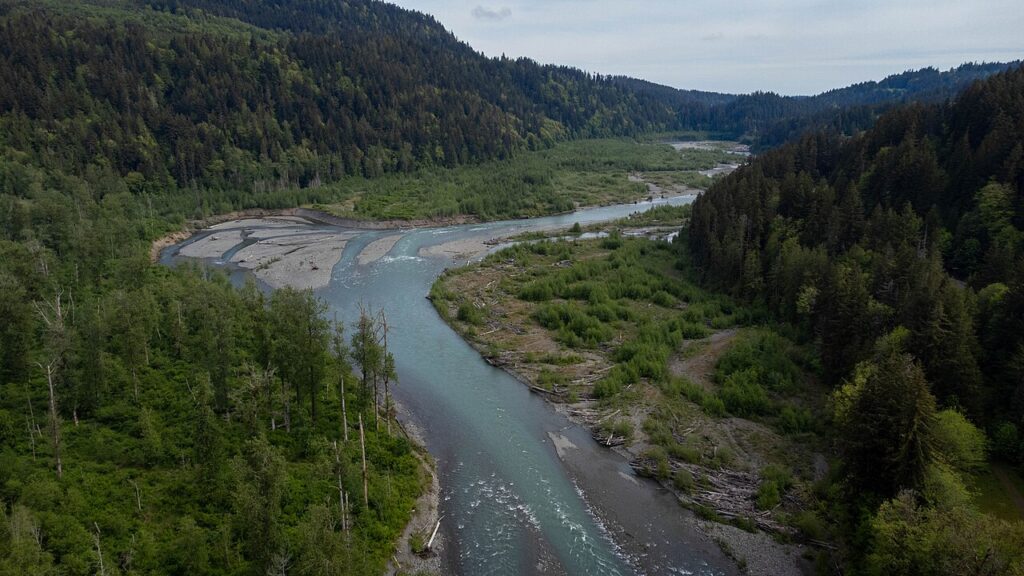
The lower Elwha lost most of its riparian forest. The band of trees that grows along a river’s banks and eventually falls into the water. Development upstream took what remained of the room. The city of Port Angeles built water infrastructure along the floodplain, a state fish hatchery went in, and a temporary sediment treatment plant was added during the river’s dam removal between 2011 and 2014. All of it squeezed the river into a tighter corridor. Without wood to slow the current or room to spread. The river’s energy funneled through a single narrow channel at high speed.
Mike McHenry, a habitat biologist for the Lower Elwha Klallam Tribe, described the result in a January 2025 article published by Northwest Treaty Tribes, a news service of the Northwest Indian Fisheries Commission. He called it a firehose effect. That kind of velocity cuts the riverbed deeper year after year, and as the channel drops below the surrounding land, the river stops flooding outward during high water. The floodplain dries out. Side channels that once held juvenile salmon go empty, and the cold groundwater connections that keep the river livable in summer disappear with them.
The tribe has been fighting the firehose effect since the 1990s with engineered logjams. Full-size logs anchored into the riverbed and arranged to do what natural logjams did before people cleared them out. McHenry compared their function to Plinko, the game from “The Price is Right.” The wood structures are the pegs, and the water is the chip. Each time water hits a piece of wood, it slows down, changes direction. The cumulative effect across a whole reach of river is a current that salmon can actually swim against. The logjams push water sideways. Carving pools 9 to 15 feet deep where adult chinook, coho, and steelhead rest during migration.
Those pools reach deep enough to tap groundwater, which keeps them cold even in August. On the downstream margins, gravel and sediment settle into beds where salmon spawn. Algae colonize the wood, insects feed on the algae, and juvenile fish feed on the insects. So, a single structure produces a feeding ground, a resting pool, and a spawning bed all within the same stretch of river.
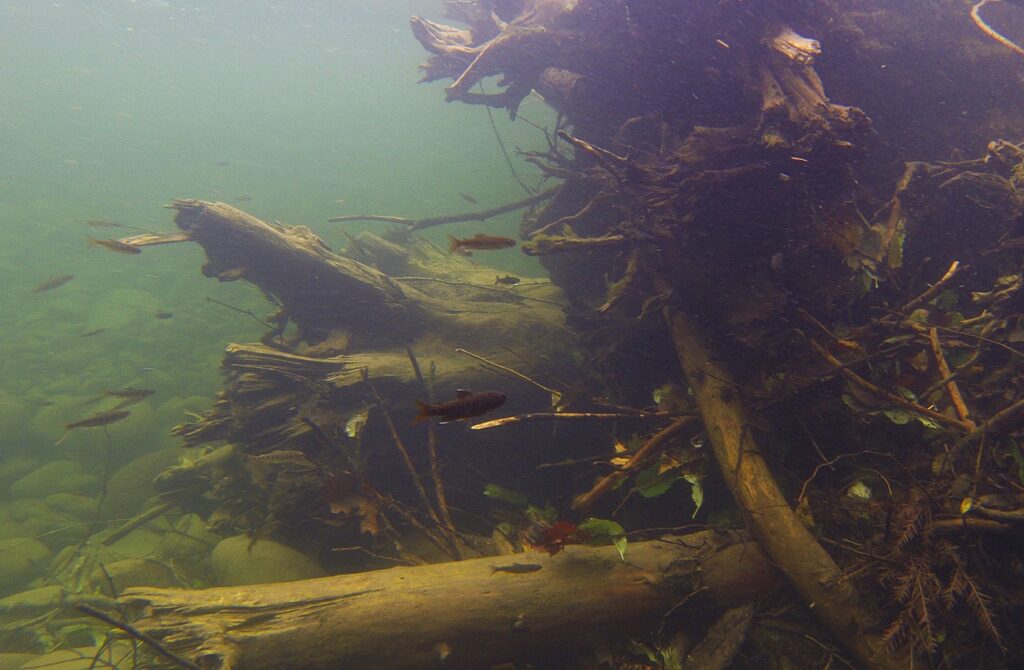
Jamie Michel, the tribe’s habitat program manager, said in the same report that the structures are designed to keep working after crews leave. Catching more wood as it floats downstream during storms. They grow and shift with each high-water season without constant human upkeep. The tribe installed 18 more engineered logjams in a single 1,760-foot stretch during 2024, bringing their total to nearly 100 over 3 decades.
McHenry said that when you pack logjams in at that density, the habitat changes are serious. New pools open, side channels form, and the structures start interacting with each other. So the river doesn’t recover in patches but reshapes itself across the whole corridor.
Where Roads Don’t Reach, Helicopters Do
Engineered logjams work. The Elwha proves it. But many of the most damaged rivers in the Northwest sit in country where old logging roads washed out decades ago, or were decommissioned on purpose. And building new ones would dump sediment into the same streams the restoration is trying to heal. Helicopters solved that problem for the Yakama Nation in central Washington, and they are now solving it farther west on the Olympic Peninsula. Where some of the region’s most important coho salmon runs are in trouble.
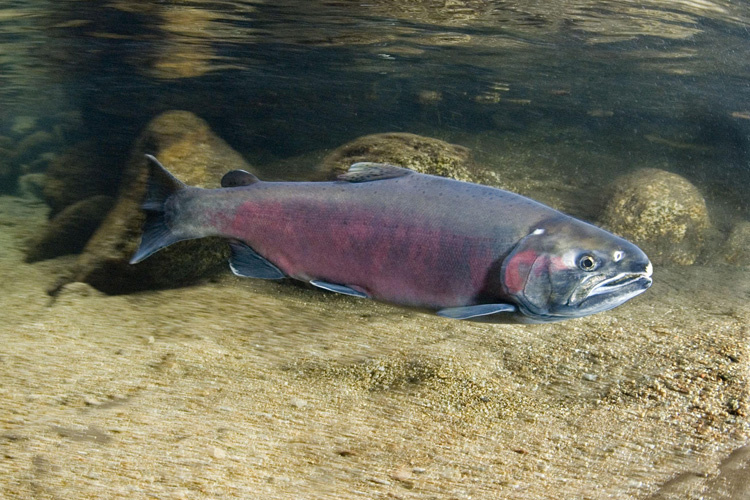
Every year, coho salmon leave the Pacific Ocean and swim back into the freshwater rivers where they were born to spawn in gravel beds and die. Their young hatch in those same streams, grow in the side channels and pools along the floodplain, and eventually head out to sea to start the cycle again. The whole thing depends on the kind of river that wood builds and holds together. In 2015, coho returned to the Queets-Clearwater watershed on the Olympic Peninsula. But so few came back that the Quinault Indian Nation shut down its salmon fishery.
A January 2026 feature published by NOAA Fisheries described the fallout. Cleve Jackson, a spokesperson for the Quinault, said that the coho not returning as projected meant fishermen lost their income and families lost a food source they had depended on for generations. The old-growth trees had been logged out of these rivers over the past century. But without that wood, winter floods scoured spawning gravel from the streambeds and carried it downstream. The main channels deepened, and the floodplains and side channels where juvenile coho shelter before heading to sea went dry.
To reverse that, the Quinault partnered with Trout Unlimited and The Nature Conservancy to begin building more than 130 engineered logjams along 8 miles of the watershed. The project is funded through NOAA Fisheries and the Bipartisan Infrastructure Law. Helicopters fly the logs in because the terrain is too remote for vehicle access. The construction also supports jobs in rural communities where the Quinault Nation is already one of the largest employers for both tribal members and local residents.
Sean Ludden, who is the Olympic Peninsula restoration project manager for Trout Unlimited. Is overseeing the helicopter-delivered construction on tributaries like Shale Creek in the Queets-Clearwater system. He is also managing a separate effort about 30 miles to the north on Owl Creek. Which is a tributary of the Hoh River.
That project is a partnership between the Hoh Tribe and Trout Unlimited, and it put 5 million pounds of wood into rock-secured logjams across 1.2 miles of stream. Between the 2 watersheds, Ludden is coordinating some of the largest helicopter-delivered logjam river restoration work happening anywhere in the Northwest right now. And the early returns have been fast. On Owl Creek, chinook salmon were already spawning around the new structures within weeks of construction.
Walter Ward-Bos, a Hoh Tribal Council member, told Northwest Treaty Tribes in a separate February 2026 report that he grew up fishing the Hoh with his father and grandfather from the mouth to the Hoh Bridge, fishing is a way of life for the tribe. Kim Bray, the Hoh’s natural resources director, said the tribe is now planning the same work on two more tributaries, Elk Creek and Winfield Creek.
Helicopter-delivered logjams are spreading beyond the Olympic Peninsula, too. Along the Klamath River on the Oregon-California border. Crews used the same method after the largest dam removal in U.S. history.
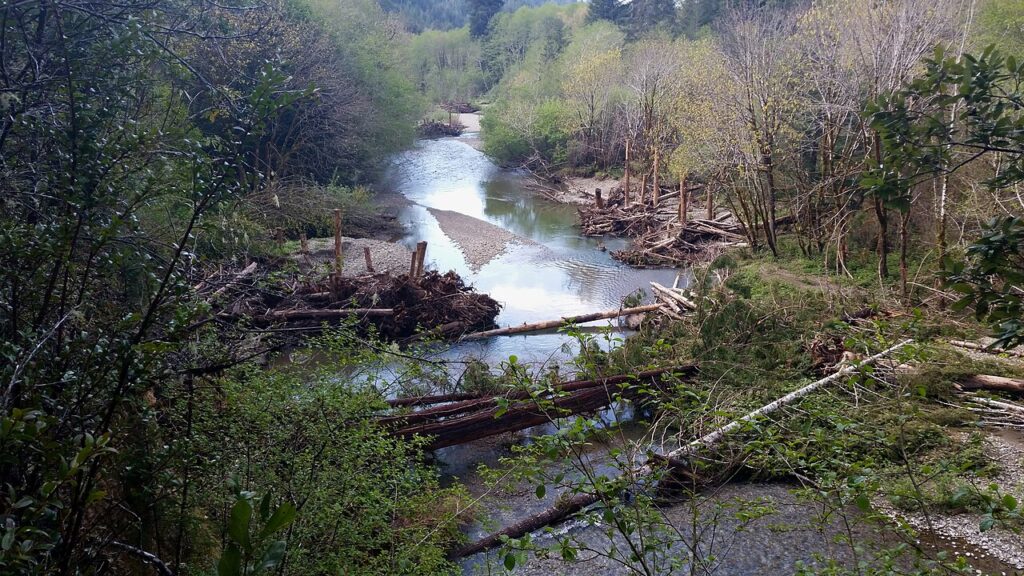
Four hydroelectric dams came online by October 2024. Tributaries that had been submerged under reservoirs for more than a century were suddenly exposed. Crews placed trees along newly opened channels like Spencer Creek. Restoring the wood that salmon need to spawn and rear in water they hadn’t reached since the early 1900s. Fish moved in and began accessing more than 10 miles of upstream habitat almost immediately.
Alongside the in-stream work on the Olympic Peninsula, crews are planting native Sitka spruce seedlings along the riverbanks. Those trees can grow over 200 feet tall and 3 to 4 feet wide, and they represent something no helicopter can deliver on a cable. One day, generations from now, they will fall into the current and form logjams without anyone’s help.
A team from Idaho State University and the U.S. Geological Survey tracked food webs and juvenile salmon production on the Methow River in north-central Washington over 2 sampling periods, roughly 6 years apart. The study, led by James C. Paris and published online in late 2024 in the journal Ecological Applications, measured invertebrate production, the total amount of insect life a stream supports, and juvenile fish biomass across multiple channels. In one side channel where restoration crews had built engineered logjams, the habitat responded fast, with invertebrate production doubling between sampling periods and juvenile salmon and steelhead production quadrupling.
But in a nearby channel where no logjams had been built. Where nobody had intervened at all, juvenile salmon production rose 17-fold over the same period. The river had accumulated driftwood on its own. Shifted its flow. Then turned that channel into a productive nursery without a single crew or piece of equipment. The engineered work delivered measurable benefits. But it did not exceed what the river produced through its own seasonal processes in a strong year. Paris and his colleagues described this as a shifting food-web mosaic. Decreases in one channel are offset by increases in another. The whole system stays productive because no single patch carries all the weight at once.
Bob Bilby, a fisheries scientist who led a 2022 monitoring review for the Pacific Northwest Aquatic Monitoring Partnership, compiled data from 13 intensively monitored watersheds studied for nearly 2 decades across the Northwest. He found wood placement improved habitat quality at some sites. But showed no measurable change at others.
Read More: Food Shortage Kills Tens of Thousands of Penguins Off African Coast
Barrier removal, things like pulling out old culverts and setting back levees, produced consistently stronger fish responses. Bilby said the one big message is that scientists don’t yet fully understand how wood in streams benefits fish populations. Even though restoration projects routinely add wood as a standard practice. A separate 2024 analysis in the journal Fisheries, led by Peter Bisson and colleagues at the Northwest Fisheries Science Center, reinforced the point. Even where freshwater habitat does improve, ocean conditions and predation can still reduce the number of adults that come back. Which means the benefits of upstream work don’t always show up in the return counts.
None of that means the logjams are wasted effort. It means they are one part of a longer process. And the river does not wait for the research to catch up. The logjams accelerate recovery in places where the wood is gone, and the river is too damaged to heal without help. But once the wood is back and the floodplain has room to move. The river starts doing the rest on its own schedule. A floodplain is a patchwork of channels and pools that shift with every flood season. The system runs on that rotation. Give it wood, room to flood, and connected side channels, and the river will sort out where the fish go.
The Sitka spruce seedlings going into the ground along the Queets-Clearwater are knee-high right now. They will take well over a century to reach old-growth size. When they do, their trunks will topple into the current. And start building logjams the same way rivers in this region did for thousands of years before anyone brought a chainsaw. That is what these projects are building toward. Not that the work happening today will be enough on its own. But that it starts the process by which enough becomes possible.
Read More: A Leopard Hides in Plain Sight Among the Sheep—Can You Spot It Before It Strikes?