
What initially seems like just a herd of mountain sheep actually hides an elusive illusion. Peering deep into the centre of the image, almost unrecognisable, lies a snow leopard. However, at first or even second glance you might miss it completely. It might take intense focus to actually spot the elusive and camouflaged snow leopard. Snow leopards are renowned for their effective camouflage, allowing them to go almost completely unnoticed to unsuspecting prey. The photograph, captured in Ladakh, India, was taken by veteran photographer Inger Vandyke. In the photograph, the snow leopard can be seen staring directly at the camera, stares directly at the camera, yet remains nearly invisible against the rocky mountainside.
The Master of Mountain Camouflage
Possessing one of nature’s effective camouflage amongst big cats. Their thick fur has a base color ranging from smoky grey to a beige-esque, yellowish tan with distinctive white undersides. Its natural coloration is of similar hues to the rocky mountainous terrain, allowing snow leopards to blend in seamlessly. Snow leopards inhabit the rocky mountainous regions across Central and South Asia. Black rosettes and spots cover their bodies, breaking up their outline and mimicking shadows commonly found on rocky slopes. The fur performs more functions than just camouflage, providing cover and warmth during the winter months. During the winter months a snow leopard’s coat grows exceptionally thick, reaching five centimeters long on the back and sides, providing isolation during winter. The belly fur extends nearly 12 centimeters in length, providing crucial insulation against extreme cold. This thickness adds an extra layer of blending capability, resembling the texture of the snowy and rugged mountain backdrop. The less distinctive markings appear to change shape with body movement, making individual snow leopard identification far more challenging compared to other big cats like tigers or jaguars.
Physical Adaptations for Extreme Environments
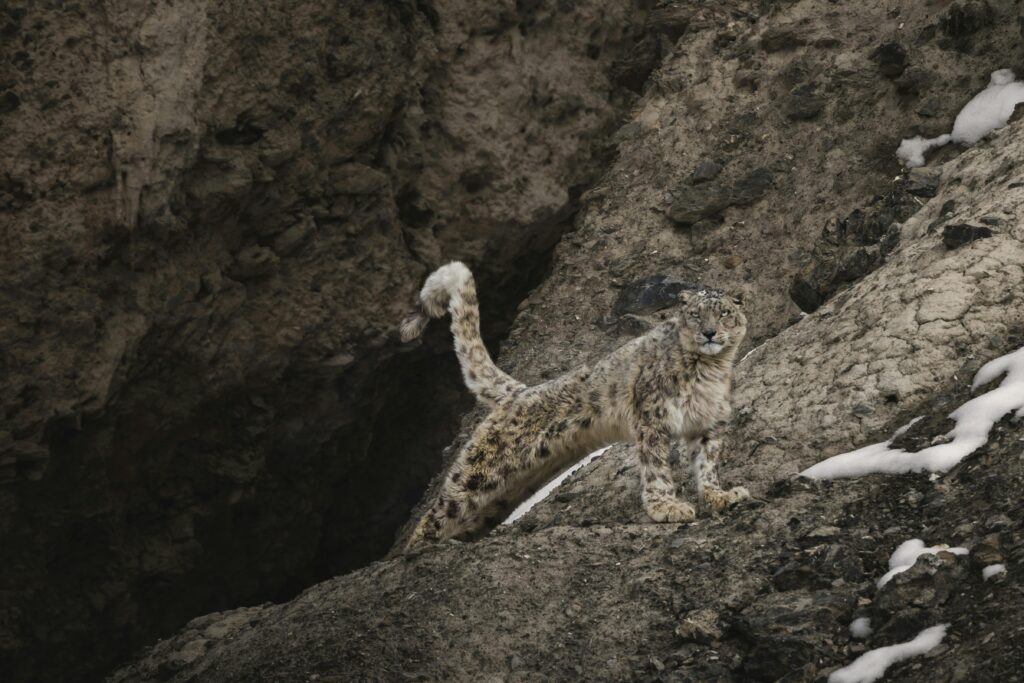
Snow leopards also demonstrate remarkable adaptations for surviving in high-altitude conditions. These cats measure 39 to 49 inches in body length, with tails adding another 31 to 39 inches. 70% of the cat’s total body length is attributed to its tail alone and the tail also serves critical functions. Adult snow leopards weigh between 80 and 120 pounds, standing roughly 2 feet tall at the shoulder. Their compact, muscular build enables navigation through steep slopes and treacherous terrain at elevations reaching 5,000 meters above sea level. The paws of snow leopards function as natural snowshoes, distributing weight evenly across deep snow. Large and covered in dense fur, these paws prevent the animals from sinking while moving silently across their territory. Sharp retractable claws provide excellent grip for climbing rocks and capturing prey. The wide nasal cavity warms frigid air before it reaches the lungs, allowing efficient breathing in the thin mountainous atmosphere. Short front limbs combined with powerful, elongated hind legs enable the snow leopard to launch itself up to 30 feet in a single leap.
The Tail: More Than Just Balance
A snow leopard’s extraordinarily long tail also provides essential functions pivotal to a snow leopard’s survival. When navigating rocky terrain or making dramatic leaps across crevasses, the tail acts as a counterbalance and rudder. This allows precise mid-air adjustments during hunting pursuits or escape maneuvers. The tail stores significant fat reserves, providing energy during periods when prey becomes scarce. During rest periods in extreme cold, snow leopards wrap their thick, furry tails around their bodies, creating additional insulation against temperatures that plunge to negative 30 degrees Celsius. Stories from field researchers describe snow leopards waving their tails to attract curious prey closer to them. While this behavior remains difficult to verify scientifically, the tail certainly functions in communication and social bonding. Mother snow leopards use their tails to guide cubs, with the prominent white tip on the underside serving as a visual marker. The prehensile-like quality allows these cats to use their tails almost as an additional limb.
Exceptional Vision and Sensory Adaptations
Snow leopards possess vision specifically adapted for hunting in low-light conditions at high altitudes. Their eyes contain a structure called the tapetum lucidum in the back of the retina. This reflective layer bounces light back through the retina, increasing the amount of light detected by the eye. The adaptation provides excellent night vision, allowing successful hunts during the dim light of dawn and dusk. The tapetum lucidum creates the characteristic glowing eyes often seen in nocturnal animals when caught in light beams. The orbital structure of snow leopard skulls shows more anteriorly oriented positioning compared to other big cats. This configuration provides greater overlap in the visual fields of both eyes, resulting in superior stereo vision. Combined with their relatively short rostrum, this adaptation proves essential for prey discovery and focusing in open mountainous regions. Wild sheep and goats display protective coloration against rock cover, making enhanced depth perception crucial. The snow leopard’s enlarged retinas enable detailed focus even under harsh glare or poor visibility conditions common in Himalayan environments.
Hunting Strategy: Patience and Precision
Snow leopards employ a stalking and ambush hunting style when hunting for prey. These cats are opportunistic predators whose distribution coincides closely with their principal prey species. They follow animal trails made by livestock and wild ungulates, using natural relief features to conceal their approach. Research shows snow leopards commonly ambush from above, causing prey individuals to flee downhill. The cats pursue their targets approximately 50 to 70 meters before subduing them at the bottom of drainages, where prey lose momentum. Photographer Inger Vandyke documented the first close-range images of a snow leopard hunt in Ladakh, India. She explained to the media that she and her guests tracked an old male snow leopard for several days. When they found him sleeping on a rock ledge at 2 PM, Vandyke predicted he would hunt at dusk. Despite temperatures reaching negative 10 degrees Celsius, the group waited patiently. When blue sheep entered the valley hours later, the old leopard woke and crept down the scree slope, finding the perfect hiding spot before launching his ambush.
Prey and Feeding Patterns
The 3 most important prey species for snow leopards are blue sheep, Asiatic ibex, and argali. These wild sheep and goats form the foundation of the snow leopard’s diet across their range. Snow leopards can kill prey up to three times their own weight, though they prefer animals in the 80 to 170 pound range. A single large ungulate kill occurs every eight to 15 days on average. One blue sheep can sustain a snow leopard for up to two weeks, though the cat typically stays with a kill for 3 to 4 days. An adult snow leopard requires approximately 20 to 30 blue sheep equivalents per year to survive. This means a single cat requires a minimum population of 100 to 150 hooved animals of various species living within its home range. Snow leopards also hunt smaller prey, including marmots, hares, pikas, and birds,s when larger game proves scarce. Genetic analysis of snow leopard scat confirms these key prey species across all five countries where the Snow Leopard Trust conducts research. The cats sometimes prey on domestic livestock, particularly stragglers left behind in pastures, which causes contention amongst livestock herds wanting to protect their livestock.
Territory Size and Solitary Lifestyle
Snow leopards lead predominantly solitary lives, only associating with others during brief mating seasons. The amount of space each individual requires varies dramatically based on prey availability and habitat quality. Research using GPS-collared cats in Mongolia’s Tost mountains revealed average home ranges of 220 square kilometers for males and 130 square kilometers for females. However, in Nepal’s high prey density areas, home ranges shrink to just 12 to 39 square kilometers. Conversely, in areas with scarce prey, territories can exceed 1,000 square kilometers. These solitary hunters mark their territories wherever they roam, communicating with other snow leopards through scent marking. They do not maintain a permanent den; instead, they sleep in different spots nearly every night. This nomadic behavior allows them to track and pursue prey across vast distances. Snow leopards can travel over 25 miles in a single night, following the seasonal migration patterns of their prey. Research revealed a concerning finding that 40% of protected areas within snow leopard habitat are too small to host even one breeding pair of cats.
Endangered Status and Population Decline
The International Union for Conservation of Nature currently lists the snow leopard as Vulnerable on the Red List of Threatened Species. Global population estimates range from 3,500 to 7,500 individuals across their entire range. The species was downgraded from Endangered to Vulnerable in 2017, though this decision was met with resistance and seen as controversial amongst the conservation communities. Many scientists argued that insufficient evidence supported the status change, noting that population decline continues in numerous areas despite protection efforts. China harbors approximately 4,500 snow leopards, representing 60% of all snow leopard habitat globally. Mongolia hosts roughly 1,000 individuals, while Nepal released its first consolidated national estimate in 2025, placing its population at 397 individuals. Despite covering just 2% of global snow leopard habitat, Nepal hosts nearly 10% of the global population, making it the fourth largest population worldwide. Some positive trends emerged, with Bhutan’s confirmed snow leopard numbers increasing 40% since 2016, and India’s Himachal Pradesh region showing increases of around 18%.
Critical Threats to Survival
Poaching is one of the most immediate threats facing snow leopard populations globally. Between 2008 and 2016 alone, 1 snow leopard was reportedly killed and traded every day, totaling 220 to 450 cats per year. The true extent remains even higher, as much illegal trade occurs completely hidden from authorities. Snow leopards are killed for their beautiful pelts, bones, teeth, and claws. Traditional medicine practices drive demand for body parts despite no scientific evidence supporting curative properties. Approximately 90% of poaching occurs in just five countries: China, Mongolia, Pakistan, India, and Tajikistan. Retaliatory killing by herders may account for more than half of all snow leopard deaths. When snow leopards prey on domestic livestock, they create catastrophic economic losses for herders who are often economically disadvantaged. A Nepal study documented 373 livestock lost to snow leopards in 12 months, representing 3.4% of total livestock and $132,450 in financial value. Climate change threatens two-thirds of snow leopard habitat, with the Tibetan plateau already warming three degrees Celsius over the past 20 years. Projections show habitat could decrease 23.4% under high emissions scenarios, while blue sheep habitat could decline 49.7%. These changes push both predator and prey to ever higher altitudes, shrinking available habitat dramatically.
Read More: There’s Supposed to Be a Leopard in This Picture and Some of Us Have Gone Crazy Trying to Find It