
A few dark specks on a sheet, windowsill, or skirting board can make an ordinary room feel suddenly suspect. The reaction is usually immediate and deeply familiar. Disgust arrives first, closely followed by uncertainty. Are those marks nothing more than dust, old grit, or stray insect waste, or do they point to something far more unwelcome? Bed bugs, cockroaches, mice, termites, bats, and geckos can all leave behind traces that look deceptively similar at first glance. That is precisely what makes pest dropping identification so important. Household droppings do not announce their source, and quick assumptions often lead people in the wrong direction. Accurate identification depends on calm observation and close reading.
Size can be revealing. Shape is often even more informative. Texture adds another layer of evidence, while placement can be just as telling as the material itself. A tidy spill beneath dry timber suggests one kind of intruder. Pepper-like specks near the kitchen cupboards suggest another. Dark, ink-like dots along mattress seams raise a very different suspicion altogether. This guide sorts those clues into practical household categories, drawing on information from official agencies and university extension sources. It explains how bed bug droppings, spider droppings, insect poo, rodent pellets, and wood-damaging frass tend to differ in real domestic settings. It also shows when droppings create a strong case for concern, and when they still fall short of proof on their own. By the end, a stain on the wall or a pellet on the floor should feel less like a mystery and far more like readable evidence.
Start With Shape, Scale, and Location
The first rule of pest dropping identification is simple. Never try to identify a pest from color alone. Black specks can come from bed bugs, cockroaches, rodents, bats, or ordinary household grime. Brown debris can come from carpenter ants, drywood termites, or crumbling timber. White-tipped pellets may point toward geckos. Splattered marks can come from spiders, flies, or other insects that rest on walls and ceilings. That is why trained inspectors read droppings as a cluster of clues. They do not rely on one clue alone. The University of Arizona offers a useful warning on that point. Droppings can help identify the species, yet they are not conclusive when viewed in isolation. Begin by checking the scale carefully. Ask whether the material resembles pepper, blunt granules, pointed pellets, sawdust, or a sand-like spill.
Then ask whether the pieces look uniform or mixed. Uniform pellets often suggest a consistent source, such as termites. Mixed debris containing fragments and insect parts can point toward carpenter ants. Next, examine exactly where the material sits. Bed bug fecal spots cluster around resting sites. Rodent pellets often appear along travel routes and wall edges. Cockroach droppings gather in corners, cracks, cabinet hinges, and damp hidden spaces. Termite pellets collect below kickout holes in timber. The room itself can offer strong clues. A mattress seam tells a very different story from an attic beam or pantry shelf. Good lighting makes those details far easier to read. A torch held from the side can reveal ridges, edges, and moisture that overhead room lighting hides.
Freshness can also change the reading completely. New droppings often look darker and more sharply defined. Older material may fade, dry out, or break apart. Cornell notes that rodent droppings are cylindrical, usually black, and lack the vertical lines seen on American cockroach droppings. That difference may sound minor at first. It can prevent a serious and expensive misreading. A homeowner who mistakes roach evidence for mouse evidence may choose the wrong control method entirely. They may set traps when the real need is sanitation, moisture reduction, and crack treatment. Cornell also reports that mouse droppings are usually much smaller than Norway rat droppings. Those measurements matter because people often call every dark pellet mouse waste. Many deposits do not fit that description at all.
For insect poo, the exact shape can be harder to interpret without magnification. Surrounding signs then become much more important. Shed skins, feeding damage, smear marks, gnawing, live insects, or stale odour can sharpen the picture. In other words, droppings belong to a wider evidence field. They rarely stand alone as proof. Read the deposit first, then read the setting around it. That slower method saves time and reduces guesswork. It keeps a harmless stain from becoming a false alarm. It also stops a genuine infestation from being dismissed as ordinary dust for another month. Good identification begins with patience before treatment ever begins. A phone photo taken before cleaning can preserve that context for later. It can also show whether the deposit repeats along a route. Surface texture also matters during close inspection. Lighting angle matters during close inspection, too.
Bed Bug Droppings Leave Sharp, Dark Clues
Bed bug droppings are among the clearest household signs once a person knows where to look. They usually appear as dark spots around mattress seams, piping, bed frames, headboards, box springs, and nearby cracks. The United States Environmental Protection Agency describes them as dark spots that may bleed on fabric like a marker. That comparison is extremely useful for homeowners. It matches what many people actually see during inspection. On fabric, bed bug fecal spots often sink in and spread slightly. They do not usually sit on top like loose grit. On hard surfaces, Cornell explains that a fecal spot may look like a brownish-black bump. On fabric, it can resemble a dark marker dot. Those details help separate bed bug droppings from loose dust, flea dirt, and ordinary debris.
Location matters even more than color here. UC IPM reports that most bed bugs are found in or near the bed. The first inspection should therefore stay tightly focused on the mattress, box spring, bed frame, and headboard. That means people should not begin by scanning the entire house randomly. A concentrated inspection around sleeping areas usually produces faster and better answers. It also reveals whether the marks cluster in real harbourage zones or simply sit on exposed surfaces. Bed bugs can hide inside cracks as thin as a credit card, so the search must stay close and exact. Check the back of the headboard, the bed legs, and the nearby screw holes carefully. Bed bug evidence also tends to arrive alongside other signs.
UC IPM explains that an infestation is confirmed by finding the bugs or their physical traces. Those traces include fecal spots, blood spots, egg cases, and shed skins. EPA likewise lists rusty or reddish stains, dark excrement spots, eggs, eggshells, and live bugs as key indicators. That grouping matters because bites alone do not diagnose bed bugs. UC IPM specifically warns against using skin reactions for diagnosis. Many different pests can bite sleeping people. Many rashes also look surprisingly similar. The stronger approach pairs the droppings with the furniture geography around the bed. Check seams, tufts, labels, screw holes, joints, folds, and the rear of headboards very carefully. Pull back any fabric coverings where possible. Use a torch and move slowly through the area. Low-level infestations are often missed because the inspection becomes rushed or too broad.
Bed bug droppings can also appear on nearby skirting boards, curtains, or upholstered chairs in heavier infestations. Even then, the bed zone remains the main stage. Homeowners should also remember what bed bug droppings are not. They are not pale wood shavings. They are not six-sided termite pellets. They are not pointed black cylinders from rodents. They are usually dark, spot-like marks tied to places where bed bugs hide between blood meals. When those marks cluster near sleeping areas, bed bugs move very high on the suspect list. Nearby clutter can widen the search beyond the bed itself. In heavier cases, adjoining furniture and nearby baseboards deserve the same careful review. Bedside tables and wall trim can hold secondary evidence. Check the nearby areas with care. Stay methodical while moving through the room.
Spider Marks, Cockroach Specks, and Other Insect Poo
Spider droppings cause confusion because many people expect neat pellets. In practice, spider waste is easier to understand through chemistry than through a standard household shape guide. Research on spider excreta identified guanine as the main purine in that waste. Later arachnology work also notes that spiders can divert or evacuate guanine as an excretory product. That chemistry helps explain why homeowners sometimes report pale or mixed stains below long-used websites. Even so, spider droppings are not standardised in household guides as tightly as bed bug or rodent signs. They should be treated as a clue, not a final verdict. If a mark sits beneath an old web, the spider explanation grows stronger. The same principle applies in a ceiling corner or near a regular retreat.
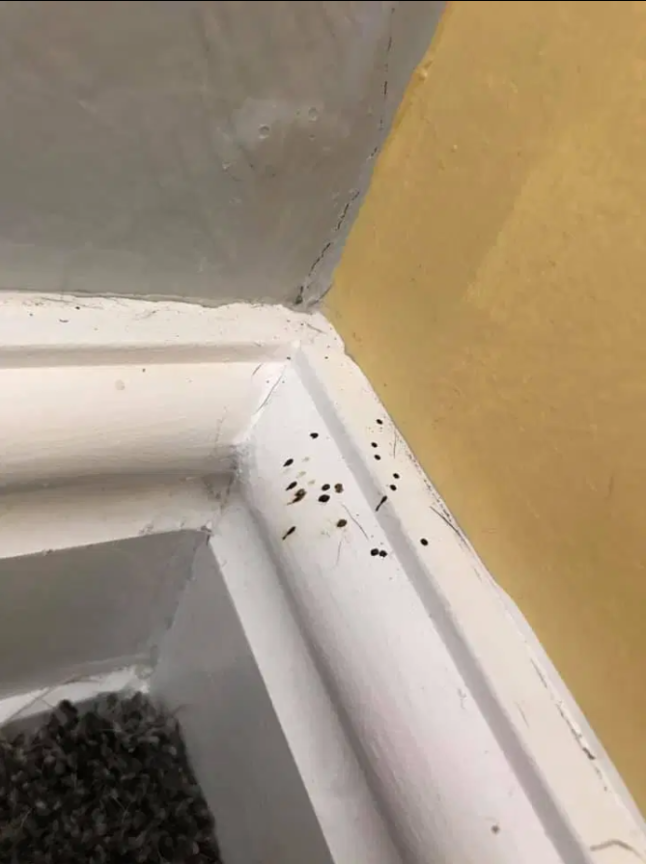
If the same room also has pepper-like granules in cupboards, cockroaches become a better fit. This is exactly where restraint becomes useful. Not every dark dot on painted plaster is insect poo. Not every pale drip below a cornice came from a spider. Read the mark together with webs, insect traffic, humidity, crumbs, and the type of room involved. That wider reading lowers the chance of blaming the wrong pest and treating the wrong place. Some insects also leave stains more often than pellets. Illinois public health guidance notes that certain occasional invaders can stain fabrics, walls, and carpets with feces. It also reminds homeowners that stains alone can mislead. Cockroach droppings are usually easier to interpret because extension sources describe a more consistent form.
Cornell explains that cockroach droppings appear to have ridges. Its American cockroach guidance adds another useful clue. Those droppings differ from mouse droppings because they have blunt ends and ridges. A small dark pellet with longitudinal lines therefore points away from mice and toward roaches. Placement helps again at this stage. UC IPM notes that cockroaches congregate in corners while foraging. They usually travel along edges of walls or other surfaces. Inside homes, that often means specks inside cabinet corners, near hinges, behind appliances, under sinks, and around warm, damp voids. Drywood termites create a very different sign. Mississippi State University says their fecal pellets are distinct, six-sided, oblong, and fairly uniform in size. They can form a neat pile below kickout holes.
They can also scatter like coarse dust when falling from higher timber. Carpenter ant frass misleads people as well. UC IPM and NC State describe it as sawdust-like material that may include wood fragments, soil, and insect parts. In other words, insect poo is not one uniform thing. Bed bugs usually leave dark ink-like spots. Cockroaches usually leave ridged dark pellets. Drywood termites leave hard six-sided grains. Carpenter ants usually leave fibrous debris behind. When those forms are read carefully, the mystery usually narrows very quickly. Even a small sample can tell a strong story when the shape matches the setting. Some deposits even mix with grease, shed skins, or wood dust. That is why the material should be read in place first. Texture often separates these deposits faster than color alone. Shape usually provides the clearest clue.
Rodents, Bats, Geckos, and Other Look-Alikes

Some of the biggest identification mistakes happen when homeowners assume every dark pellet came from an insect. Rodents, bats, and geckos create some of the most commonly misread signs indoors. Cornell says rodent droppings are cylindrical, usually black, and shaped with pointed to rounded ends. They do not show the vertical lines found on American cockroach droppings. Mouse droppings are typically much smaller than rat droppings. Those measurements matter because scale changes the whole response. A few mouse pellets behind a toaster suggest one kind of problem. Large rat droppings in a roof void suggest another, and the health stakes rise with both. The CDC says rodent droppings and gnaw marks are key signs of rodent activity. It also notes that rodents can carry diseases that spread directly or indirectly to people.
That public health angle means rodent evidence deserves more than cosmetic cleaning. Bats can also mimic rodent evidence at first glance. UC IPM says bat droppings, known as guano, crush easily and reveal shiny fragments of undigested insects. Mouse droppings do not contain those shiny fragments. That crush test can be very useful in attic spaces where both animals remain possible suspects. Attic floors, beam tops, pantry runs, and appliance voids each point toward different pests. Fresh gnawing, rub marks, and travel routes can confirm the reading. Sound and odour can support the visual clues as well. Geckos add another twist, especially in warm climates and around outdoor lighting. Texas A&M notes that gecko droppings are elongated and brownish. It also says they are frequently tipped with white.
That white tip comes from urate. It immediately separates many gecko deposits from rodent pellets or cockroach droppings. Homeowners often find them on window ledges, walls, curtain folds, garages, and covered outdoor areas where insects gather at night. The shape can still be deceptive from a distance. The white end is worth checking closely before making any conclusion. This is also where many people confuse bird or bat evidence with reptile evidence. UC IPM says bat droppings are never white or chalky like bird droppings. That single distinction can prevent a costly wrong turn. Termite pellets add another look-alike problem because they can resemble spilled grit.
Mississippi State notes that drywood termite pellets often look like dust or debris at ordinary viewing distance. Magnification then reveals their six-sided form. Across all these examples, the lesson remains unchanged. Look beyond the first impression whenever possible. Ask whether the deposit is ridged, pointed, blunt, white-tipped, shiny inside, or neatly uniform. Ask where it likely fell from. Ask what other signs surround it. The most accurate answer usually comes from that full reading, not from the pellet alone on the floor. Location and texture often finish the story. A small hand lens can settle doubts that the human eye cannot. Checking above the deposit can reveal the source opening or resting site. Check beams, sills, and ledges before assuming the floor deposit began there.
What To Do After You Find Droppings
Once droppings are found, the next steps matter just as much as identification itself. Cleaning too quickly can erase the evidence needed for a correct diagnosis. Unsafe cleaning can also expose people to unnecessary risk. The CDC gives a direct warning for rodent waste. Do not vacuum rodent droppings or contaminated surfaces before proper disinfection. The reason is simple and important. Sweeping or vacuuming dry rodent waste can push contaminated particles into the air. If the evidence looks rodent-related, ventilate the area where appropriate and wear gloves. Photograph the droppings in place before removing anything. Then follow the official cleanup guidance carefully. Bat accumulations require similarly extreme caution. CDC and NIOSH guidance on histoplasmosis gives a second warning. Disturbing bird or bat droppings can create exposure risks.
Read More: Middle Schooler Uncovers Surprising Cancer-Fighting Potential in Goose Droppings
That concern rises where guano has built up over time. For insect evidence, the main danger is usually misidentification, not aerosol exposure. The best move is often to preserve a small sample first. Photograph the deposit beside a coin or ruler. Then inspect nearby cracks, seams, or timber surfaces before wiping everything away. Good evidence beats a vague memory every time. A clear close-up can save a pest professional a great deal of guesswork. Ridges, pointed ends, white tips, or marker-like bleed can all help. Written notes on room, height, and surface can help even more. Avoid guesswork labels until the evidence truly supports them. Accurate notes also help if treatment starts later. Long-term control also depends on reading droppings as a map of conditions inside the home. EPA explains that integrated pest management works through elimination and exclusion.
It targets nesting places, food, water, and entry points. That principle applies across nearly every pest covered here. Bed bug spots point to harbourage near sleeping areas and call for close inspection, laundering, encasements, and often professional treatment. Cockroach droppings point toward food residue, humidity, leaks, hidden voids, and entry gaps. Rodent pellets point toward access holes, storage failures, cluttered runs, and shelter. Carpenter ant frass often points toward moisture-damaged timber. Drywood termite pellets point toward infested wood overhead or nearby. Gecko droppings often point toward night lighting that attracts insects. In short, droppings reveal more than the pest itself. They reveal the environment that allowed the pest to stay.
Use that information carefully and consistently. Seal any visible entry gaps carefully. Repair active leaks as soon as possible. Reduce unnecessary clutter wherever you can. Store food in tightly sealed containers. Pull beds slightly away from walls during inspection. Keep firewood away from the structure. Prune vegetation back from the house. Then decide when expert help is needed. Some signs justify professional help immediately. Bed bugs, termites, heavy cockroach activity, rats, or bat guano usually deserve a professional inspection. That step often produces the fastest, most reliable answer and the best plan. Correct identification is the first treatment step, not a side issue. Good pest control starts with correct reading, then targeted action. It also reduces pesticide use where nonchemical correction would solve the problem. Precision matters greatly in pest work. Act precisely once the evidence is clear.
A.I. Disclaimer: This article was created with AI assistance and edited by a human for accuracy and clarity.
Read More: 13 Innovative Ways To Use Salt and Vinegar Around The Home