
Solar energy is often praised for being cleaner and more sustainable than other power sources. For example, fossil fuels are finite, their sources are depleting, and they cause air pollution. Meanwhile, solar energy uses sunrays, which are unlimited and abundant (albeit weather-dependent). However, there’s an aspect to solar energy that is not environmentally friendly: land use. Solar panels take a lot of space, and large-scale energy production can come at the cost of farmland and natural woodland. It’s difficult to praise a renewable energy source when it comes with the destruction of the environment it’s supposed to protect. Fortunately, scientists have developed a creative solution in the form of solar trees.
Protect Real Trees With Solar Trees
Image Credit: TMJ4 News
Unlike solar panels that stretch across fields or rooftops, solar trees don’t need much ground. Their “trunk” is rooted into the earth, and overhead, their “branches” are laid with solar panels. They function identically to regular panels but require much, much less land. Their design provides another important perk. They can provide shelter from rainstorms and heatwaves. This makes them an asset to public spaces, where they can power homes, commercial establishments, streetlights, and charging stations. Various companies offer solar trees with varying designs, but the end goal is the same.
One brand is Solar Forma Design, which made headlines after installing their structures at a park in Milwaukee, U.S. Their creations are called E-Cacias, since they were modeled after the large umbrella canopy of African acacia trees. E-Cacias serve as functional art pieces, providing shade to people, power to the scoreboard and lamplights, and awareness of the potential of solar energy. All the while, minimal space is taken away from the park and its visitors.
“Renewable energy… is rightfully under speculation as to whether it can do what it needs to do to provide our energy needs,” said Brian Graff, the CEO and founder of Solar Forma Design, to TMJ4. “And by integrating it into human spaces, we can create confidence in that energy, confidence in the technology, and we can inspire adoption and uptake.”
The Supertrees of Singapore
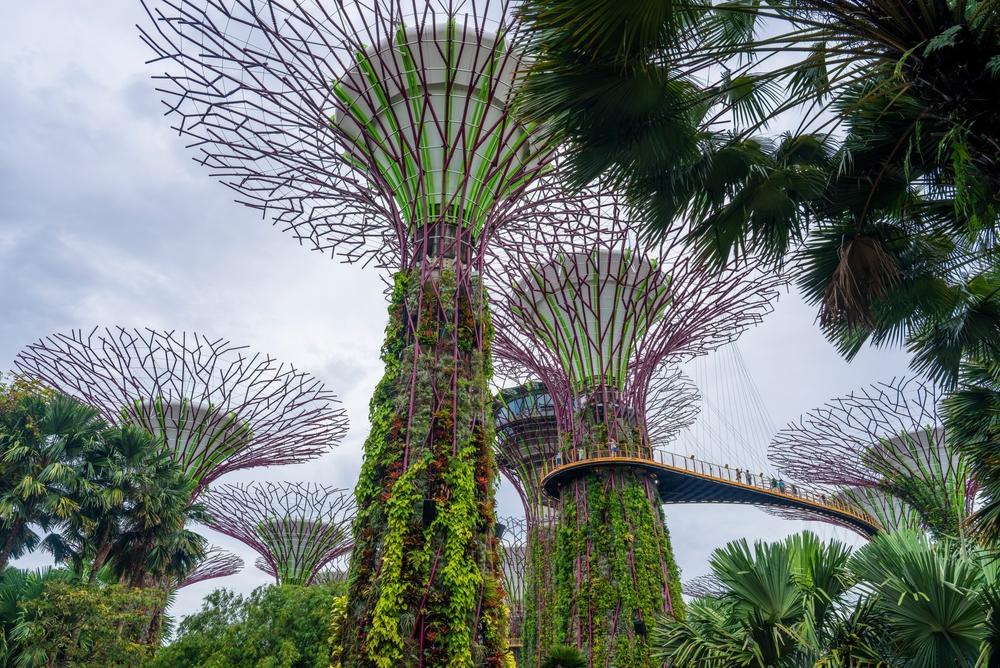
Image credit: Shutterstock
E-Cacias are only one example of solar trees, which is perfectly understandable since there are many types of trees. Are acacia trees truly the most effective design? Perhaps not. The landscape architecture firm Grant Associates took inspiration from Australia’s Karri species when creating their solar Supertrees. They also took fictionaldetails from the forests in Studio Ghibli’s Princess Mononoke.
The Supertrees are perhaps the most recognizable of solar trees after being shown in Crazy Rich Asians and The Bachelor. They have become a landmark of Singapore’s Gardens by the Bay. Not only do the 18 Supertrees generate sustainable energy, they collect rainwater and function as vertical gardens. The collected solar energy powers nightly light and sound shows, as well as supports the watering and cooling systems in the natural conservatory. Supertrees represent the goal of the Gardens by the Bay: the fusion of art, technology, and nature to promote a more sustainable world.
Read More: California Covers Canals With Solar Panels to Combat Drought and Produce Clean Energy
The Benefits of Solar Trees
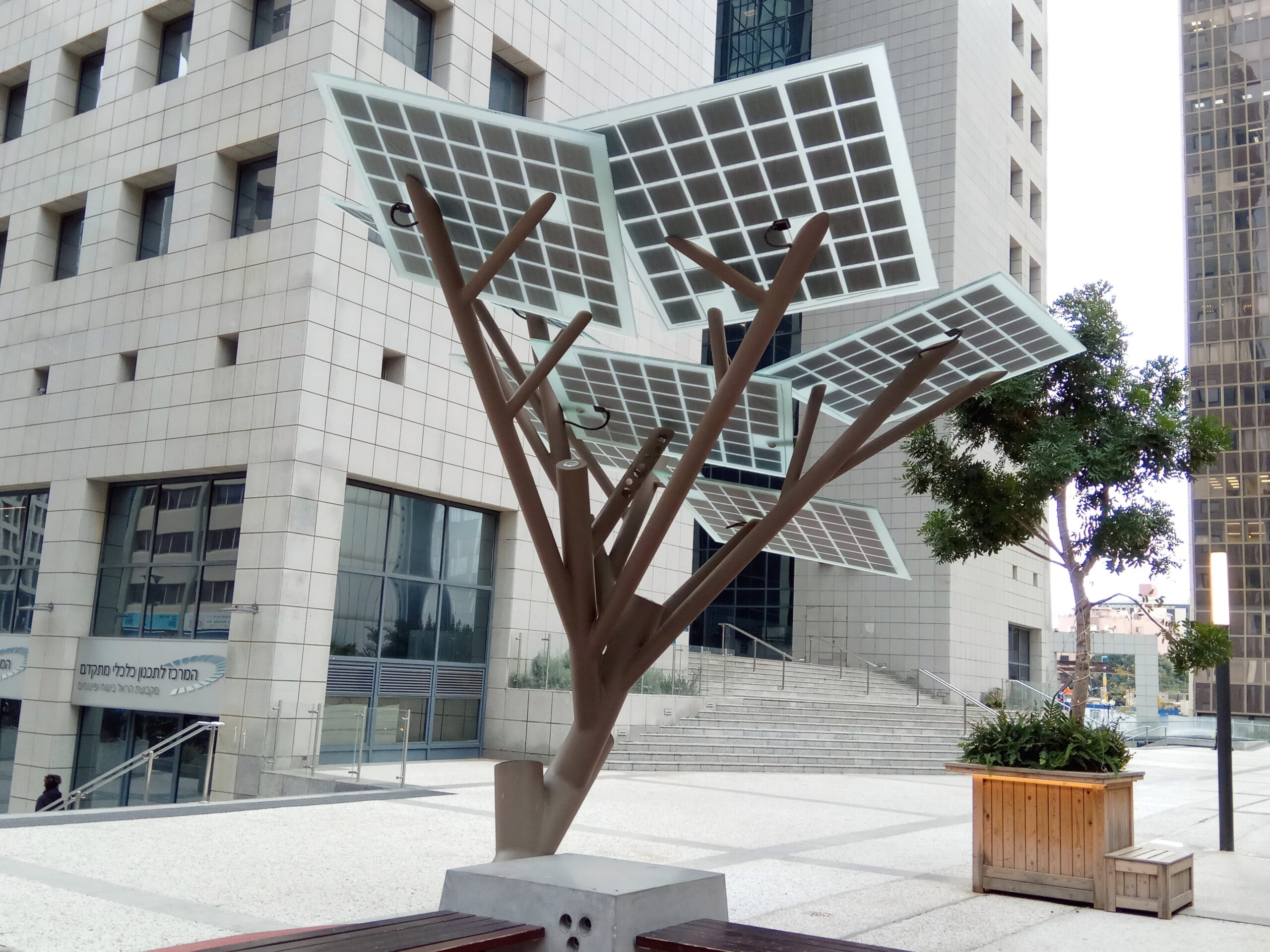
Right now, many solar trees are used as functional art pieces. They are intended to draw public attention to the importance of sustainable energy and preserving nature. They also capture the viewer’s imagination; perhaps solar trees are the way of the future. Researcher Dan-Bi Um at the Korea Maritime Institute put this idea to the test. He compared conventional solar farms to solar trees by mapping potential installations in a coastal forest in South Korea.
The team made an astounding discovery. “Through 3D geospatial simulations and standard test conditions, we show that linear arrangements of solar tree structures preserve 99 percent of forest cover,” they wrote in the 2025 study. Other researchers have investigated the impact of individual units but that doesn’t reflect how solar trees would actually be utilized. “…Although our study centers in South Korea, the methodology has broad applicability for other nations looking to expand renewable energy while preserving forest ecosystems.”
Solar trees are versatile by design, which is why they can appear in public parks, conservatories, and woodlands. Meanwhile, solar panels are limited to rooftops and sprawling fields. If you can “plant” an energy source practically anywhere, the potential is practically limitless. Imagine them powering carports, outdoor malls, charging stations, Wi-Fi hotspots, vertical farms, and air purification systems. Their installation is undeniably expensive, but long-term, solar trees can save money along with the planet.
Read More: Australia Plans to Build World’s Largest Renewable Energy Hub Featuring 60 Million Solar Panels